
Retro Review by Andrew Swafford
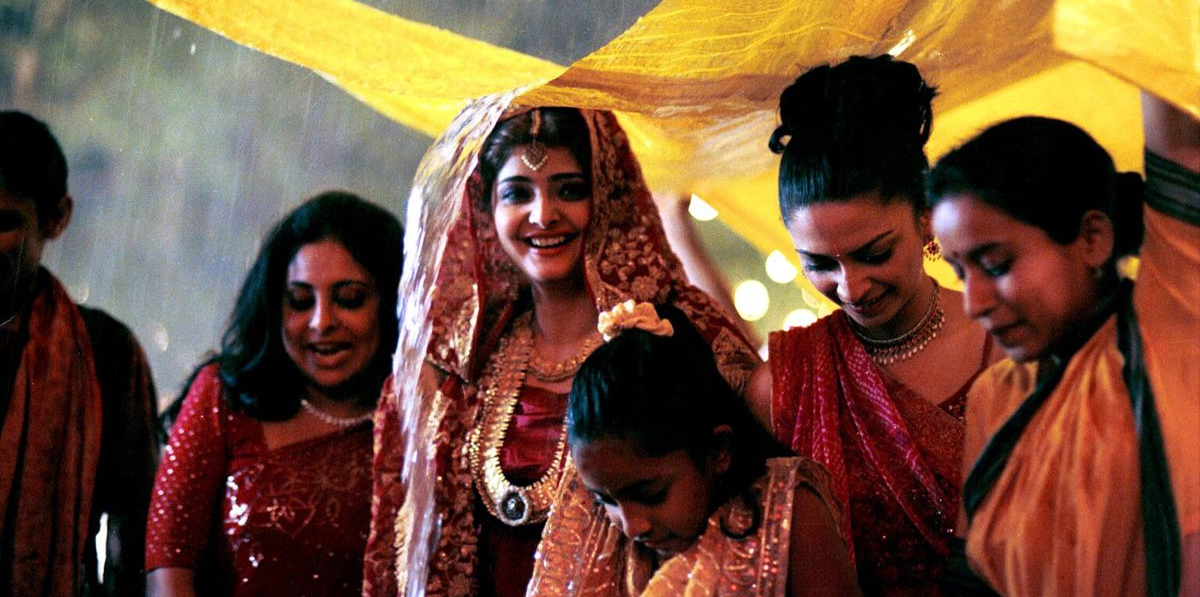
The title Monsoon Wedding suggests a type of “rain on your wedding day” comedy in which everything that can go wrong does--and yes, the family’s rented waterproof tent does come in handy for the marriage scene. Any gathering on such a mass scale has the potential for disaster, of course, but Mira Nair’s film about a traditional Hindu arranged marriage in contemporary India is not so much about the event’s potential stressors, despite their constant presence. Rather, the film is a celebration of all the ways that people come together: as couples, as families, and as cultures.
There’s no true protagonist in Monsoon Wedding--it is, appropriately, an ensemble affair--but the center of the action has to be the bride, Aditi. She has agreed to be wed to a man of her parents’ choosing, despite already being in an on-again-off-again relationship with a married man. When we first see her, she is going to visit the side-man at his work, which is on a talk show set where the subject of censorship of Western media (porn, specifically) is being discussed. The two share a passionate moment, but Aditi soon becomes resigned to her immediate fate of being married to the unknown man who will be willing to devote himself entirely to her. When the groom arrives just in time for the preparation of the wedding, the audience learns that he’s travelled from Houston, Texas and plans to move back with his new bride, who will leave behind everything she’s ever known in India. The wedding is an enormous undertaking, with elaborate decoration/construction being carried out around the primary characters at all times, as well as far too many extended family members to keep track of, many of which are citizens of other nations (Bangladesh, Australia) visiting their ancestral homeland for the first time.
Obviously, this is a film about much more than just matrimony or love--and it’s interesting to see a story of arranged marriage from a female director who doesn’t seem bothered by the concept. The film’s true heart is with the intersections between cultures, and the way in which Mira Nair’s Indian culture is now inextricably “married” to European and American influence, as can be seen in so many elements of the narrative. Even the production of the film itself is a reflection of this, as it was an international production that required the cooperation of studios/distributors in India, the USA, Italy, France, and Germany. The mise-en-scene of Monsoon Wedding is also littered with artifacts of globalization, including a shot in which native Indian characters ride a cart through a golf course, passing lines of colorfully-dressed women carrying baskets on their heads while a skyline of skyscrapers sits in the background. Early versions of cell phones also abound.
The way in which the blending of Indian/European cultures is most apparent is through language. All throughout Monsoon Wedding, characters fluctuate between speaking in Hindi and English, often within the same sentence. While there are some characters who speak only Hindi (mostly the working-class hired assistants) and others who seem to only speak English (the Texan groom, an Australian family member), most characters use a fluid combination of the two, and watching the film with subtitles becomes a necessity for all cinephiles other than the bilingual. Though this type of language hopping has also been used in films like Spanglish and Real Women Have Curves, I feel that those movies draw attention to their own linguistic barriers/bridges much moreso than Sabrina Dhawan’s script for Monsoon Wedding, which never points out what it’s doing explicitly and jumps back and forth in a way that seems extremely second-nature, as it would to the characters. My favorite example of both languages coming out at once is in a two-word sentence, when a character from India calls a character from Bangladesh a "bloody foreigner"--the first word in English, the second in Hindi--which is a pretty ironic, considering she's using the slang and language of imperialists to make fun of someone for not being Indian.
The way I feel that Mira Nair’s film is most reflective of cultural exchange, though, is through music. Though this isn’t a Bollywood musical, it’s an extremely melodic film, and it isn’t unusual for a dinner table conversation to transform into a chorus of traditional Hindi music, while a television set in another room plays what sounds like 80s-era MTV.
These examples so far have all been juxtapositions, though--Indian culture over here, European culture over there, all contained in the same scene. Other examples of music in the film show a true and organic blending of both worlds into something entirely new. The soundtrack to Monsoon Wedding (composed and compiled by Mychael Danna) is a vibrant and colorful collection of sounds that sounds at once inspired by ancient devotional/folk music in its melodies and instrumentation, as well as European dance and hip-hop music in its beats and synthesized leads. I think the film’s best example of the coming together of musical forms can be seen in the music video for this standout track, “Chunnari Chunnari.”
(Seriously, watch that.)
Notice how the thick, buzzy keyboard lead feels completely integrated with the percussion section, which is made up of a bunch of auxiliary hand drums rather than a singular drum kit. The vocals are in Hindi and the scale is certainly one you wouldn’t hear on the radio in the West, but the repetition and staccato rhythm of the hook feels more like American pop or dance music than anything else. Once the track hits the 1:45 mark and the vocals drop out, there is a quick sample/drum break that is lifted straight from 80s hip-hop/turntablism before the song pulls in a rock drum set for an extension of this instrumental section. Looking at the visuals, it’s worth pointing out that the male lead starts wearing a jacket with an American flag patch on the shoulder at around the 2:25 mark, and both singers dancing in front of the GOLDEN GATE BRIDGE at about 3:40.
Mira Nair and her composer Mychael Danna use this track twice in Monsoon Wedding, and the second time is for the film’s climax. Two characters (one the brother of the bride, the other a female cousin) have been choreographing a dance to “Chunnari Chunnari” to present the night before the wedding, but the boy drops out at the last minute after being shamed by his conservative father for being too effeminate. When the song begins to play over the wedding party’s loudspeakers, the cousin goes ahead on her own, noticeably nervous. Partially successful and partially awkward, the dance continues solo for about a minute or two before, one by one, family members begin jumping in to join her, until ultimately the entire wedding party--even the previously shamed, possibly closeted brother of the bride--is caught up in the song’s cosmopolitan rhythm.
This dance is the moment of ultimate “coming together” in Monsoon Wedding--members of both families, many of which coming from cultures, nations, and ideologies that might normally be seen as combatants, joining together in music for a ceremony of unity. (There’s even another song after this one in which the lower-class employees join the dance as well.) This film is the reverse-Tokyo Story, in which modernity is exciting rather than a sign of impending doom, and--crucially--estrangement can be overcome. It's no wonder that the credits of Monsoon Wedding begin with a dedication: for my family.
Of course, all of this talk of multiculturalism and Western influence throughout India would not be the case if not for the historical atrocities of colonialism and imperialism, and it might seem coarse or tonedeaf of Mira Nair to present the positives without touching on any of the negatives. Perhaps this is why she included a long-repressed family secret (not to be spoiled) that comes bubbling to the surface when the family is in such close quarters for an extended period of time--could this represent the West’s exploitative relationship with India in the past?
Ultimately, I’m not sure it matters. Monsoon Wedding isn’t a Claire Denis film, nor is it Only God Forgives--but those movies also exist and you can watch them instead/also if you’d like a more eye-opening experience. Mira Nair’s not concerned with the political ramifications of European presence in her homeland, as it is all her characters have ever known and it is part of what makes their lives enjoyable. This one is a wedding, not a funeral.