
Review by Jessica Carr
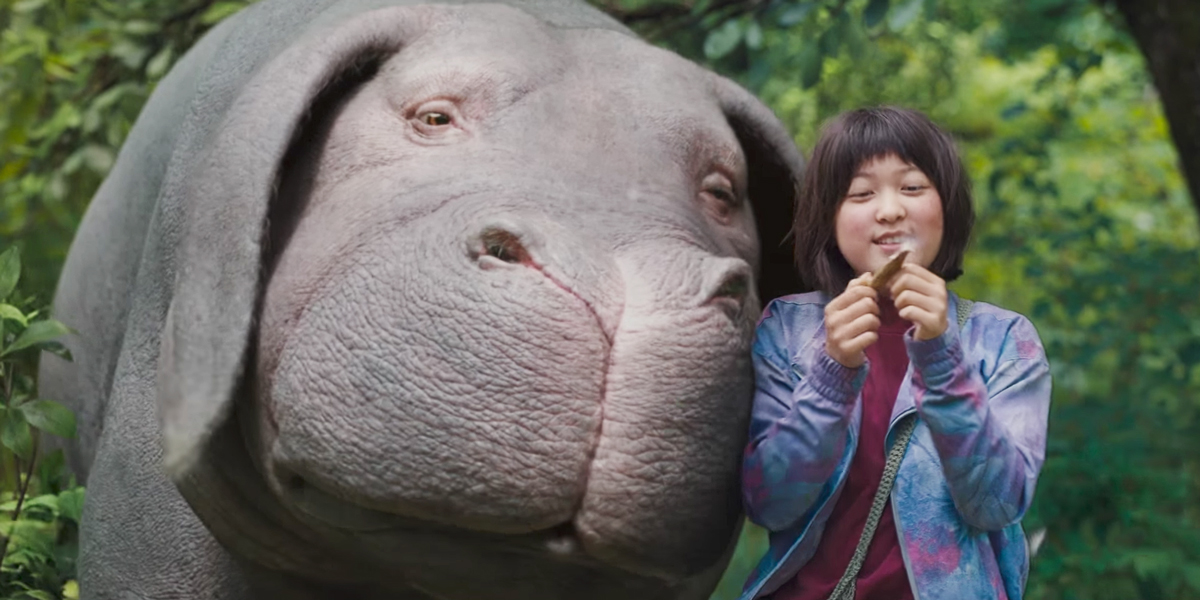
A cuddly super pig and an adorable Korean girl with a bowl cut explore the mountains of South Korea together. They pick fruit, take naps and gather fish for dinner. This friendship sounds like the perfect basis for a Disney-esque kid’s movie, but director Bong Joon-ho had other plans for Okja. Instead, we are given a thought-provoking film about corporate greed seen through the eyes of a strong female protagonist. Okja has an undoubtedly pessimistic world view, but in the end there is at least a small glimmer of hope for humanity.
Earlier this year, the Netflix original movie received some negative attention after being booed at the Cannes Film Festival when both the Netflix logo appeared and when it was played with the wrong aspect ratio. But despite the ongoing debate about movies made by streaming services, Okja still managed to get early praise from film critics. And personally, I was completely overjoyed by the release of Okja. I made plans to watch the film on a larger screen, and I still managed to have a nice cinematic experience despite not being able to watch it in a theater.
The first act of the film follows Mija (Seo-Hyeon Ahn) and her super pig Okja on a farm in South Korea. Mija’s grandfather is a farmer and was chosen by the Mirando Corporation to raise one of 26 super pigs for their competition. After 10 years, the corporation checks on each pig to determine who the best (and fattest) super pig is. To the audience and Mija’s dismay, Okja is chosen as the winner. She is to be transported to New York City for the company’s super pig parade. However, members of the Animal Liberation Federation (ALF) want to use Okja as a pawn in their takedown of the Mirando Corporation. The second act projects a dark tone as the ALF allow Okja to be captured and taken to a lab where super pigs are the test subjects. This gives ALF the footage they need to expose the Mirando Corporation’s big secrets at the NYC parade.
I agree with those that say they would’ve loved a movie consisting entirely of Mija and Okja's adventures in the mountains of South Korea. I felt a warm feeling deep in my soul when Okja propped up and wrapped her arms around Mija. It is clear from the first 30 minutes of the film that this relationship means everything to Mija. I was getting some serious My Neighbor Totoro vibes when Mija was lying on Okja’s belly surrounded by nature. Their relationship becomes the basis for everything in the film. It is the one connection that seems uncorrupted by greed or any other motivations. Once Okja is taken away from Mija, her whole demeanor changes. She would do anything to get back her best friend which is clearly what is driving her character.
Mija and Okja are probably the purest characters in the whole movie. It is obvious what drives both of them. The same can’t be said for the plethora of other characters that are introduced. Let’s start with Lucy Mirando played by the Goddess Tilda Swinton. She is like most narcissist CEO’s but with added eccentrics. She has a twin sister (later revealed to also be played by Tilda Swinton) and wears clothes with her signature embroidered on them. I really love the opening scene where she is basically giving what looks like a TED talk about the super pig competition and every word is dripping with insincerity. I especially love the line, “And most importantly, they need to taste fucking good.” Her character is entirely motivated by greed and greed alone.
In terms of character development, I think Bong’s film Snowpiercer has the upper hand. His characters there seemed more multi-faceted. However, there are some characters here that are more complex. Like when ALF member K (Steven Yeun) purposefully mistranslates Mija’s response as a yes when she really says no to the ALF’s plan. ALF leader, Jay (Paul Dano), eventually beats the shit out of K for his betrayal. But later, K shows up apologetic with a tattoo that says, “Translations are sacred.” I thought it was a subtle way to show that people can be selfishly motivated for their own cause, but they can also own up to their mistakes. The scene also show how important communication is. Okja and Mija understand each other despite being from different species. In a film about greed, Bong Joon-ho still allows some of his characters to have redemptive qualities that help their humanity shine through.
However, this redemptive quality isn’t seen in all his characters. Which leads us to address the super pig in the room. I was kind of taken aback when I saw all the internet hate for Johnny Wilcox played by Jake Gyllenhaal. Wilcox is a spokesperson and zoologist for the Mirando Corporation. He says that he used to be a huge animal lover, but becomes a hot mess after repeatedly being scorned by his boss Lucy Mirando. His hatred for the company (and probably himself) causes him to take all his anger out on the animals. He really produces the most uncomfortable scenes in the film which is why I imagine most viewers felt like his character was incomprehensible and poorly casted. I can see how they could think Gyllenhaal overacted, but I don’t really think his character was unfathomable. There are plenty of people that take their self-hatred out on animals. It’s true, maybe Gyllenhaal could’ve taken it down a notch or two, but wow he was really going for it.
In the midst of an overall disappointing summer for movies, Okja was like a ray of sunshine to me. It had great action scenes, a stellar cast and a heartfelt story at the center. In a world full of sequels and remakes, Okja shined through. Even though Bong Joon-ho likes to be pessimistic about the future of humanity, he also likes to show a glimmer of hope. Remember the final shot in Snowpiercer—life fighting to exist in a snow apocalypse. That’s how the ending of Okja felt to me. It felt like in a world where greed exists, love can also exist.