Review by Alison Swafford
When asked on a CBS morning show if he would use generative AI in his future films, Backrooms director Kane Parsons responded:
“Absolutely not…For me, the whole point of doing what I’m doing — like, art is a way of processing life. That’s inherently what it’s supposed to be, for most people. I don’t see the value in outsourcing any element of that. And when I’m looking at someone else’s project, if I see an element of the environment has been — like, they used generative fill or whatever to change something about the scene — it just shuts off the part of my brain that wants to know more about that world and wants to look for details, cuz I can assume that if they’re willing to make an arbitrary choice there, they could make an arbitrary choice anywhere.”
As a public school teacher who has spent an inordinate amount of time over the past 4 years grappling with the impact of AI on student writing, Parsons’s answer strikes me as one of the most clear and cogent arguments I’ve ever heard on the matter. While it’s not as punchy and memorable as Hayao Miyazaki’s legendary description of generative AI as “an insult to life itself, ” Parsons is getting at something similarly vital. Humans create art because they are alive and need to process their feelings about being alive. AI “art,” by contrast, is something disturbingly inhuman — like human expression, but uncannily not. It serves not the purpose of expressing our humanity, but something else: efficiency, productivity, profit.
Elsewhere, Parsons has said he is interested in “interrogating [AI] artistically,” which I would argue is what his breakout feature is fundamentally doing. While Forbes and MSN, of all places, have published reviews of the film that respectively proclaim it “a critique of generative AI” and “the first horror movie of the AI era,” I haven’t found much in-depth analysis online examining what the film is actually saying about AI. (Yet — I’m sure all the creepypasta loredivers are going to churn out dozens of hours of content about the film in the coming weeks.) So the following review is my best attempt to parse what’s going on here, AI-wise, in an attempt to generate further conversation about it.

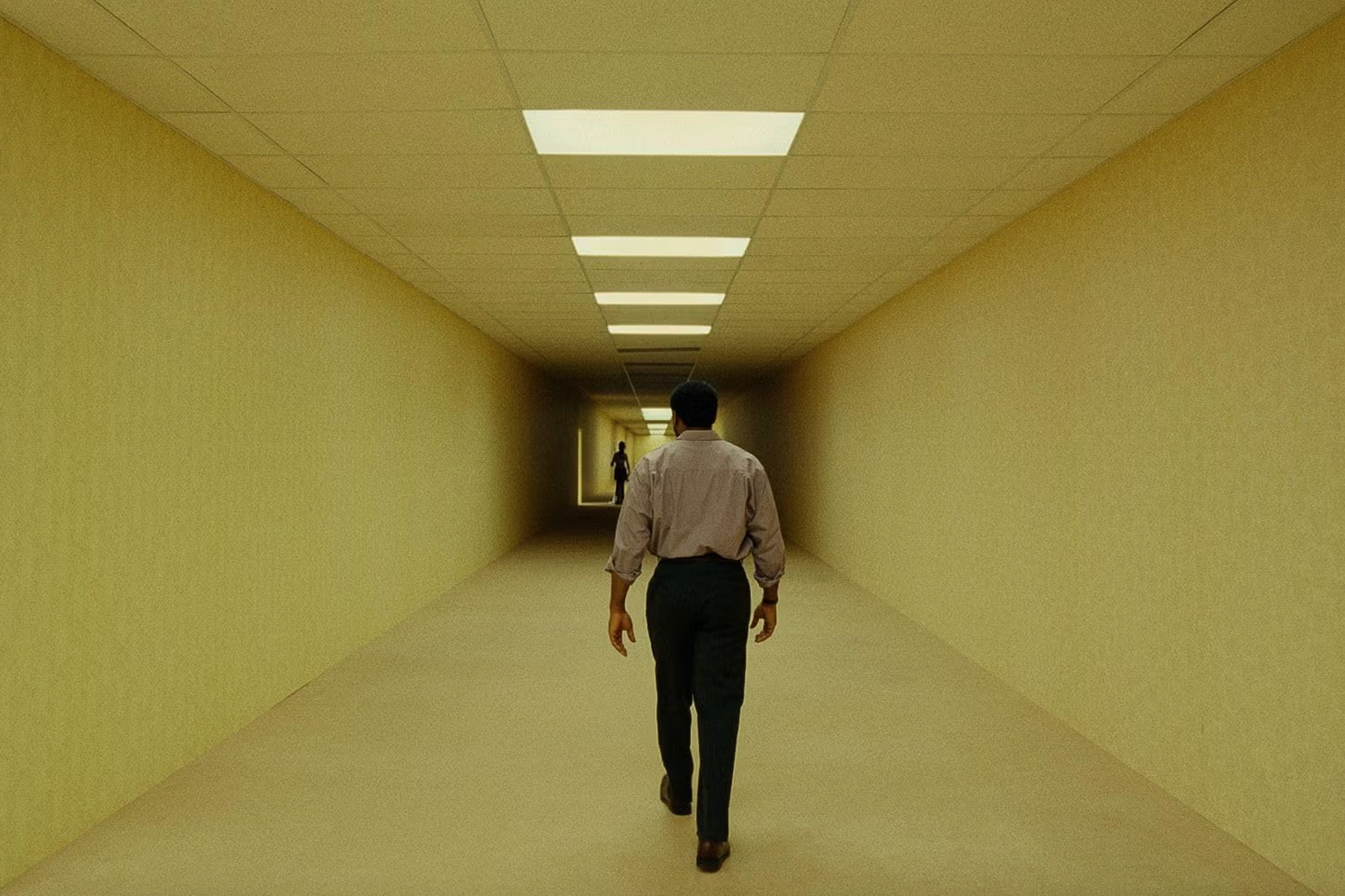
The most central image of the film (and all Backrooms-mythos-related online content, much of which has been made by Parsons) is that damn yellow wallpaper. The first poster A24 put out for the film was just a strip of blank wallpaper, and the wallpaper is hideous. Sickly yellow, entirely flat and lifeless, repeating a granular pattern that is completely uninteresting to look at. This wallpaper covers almost every inch of the Backrooms, and its so nondescript that it feels completely invisible in the failing furniture store owned by Chiwetel Ejiofor’s protagonist, Clark. Essentially the same shade of beige seen all across the walls of Dunder-Mifflin, the intentionally generic paper company from The Office, this is simply the boring, unremarkable look of commerce. Almost all of the real-world spaces the characters of Backrooms inhabit feel just like this: carbon-copy buildings painted in flat colors, with paintings on the wall that don’t mean anything and overly harsh fluorescent lighting running across their tile-based drop ceilings.
While it’s tempting to call these aesthetics a mockery of generative AI’s soullessness, it is also important to remember that Backrooms is a period piece set in 1990 — the era immediately following Reaganomics — and I think Parsons is interested not only in the present moment, but how AI is merely the latest permutation of forces that one could trace back decades if not centuries. In that same CBS interview quoted above, Parsons says that he thinks the initial horror of the Backrooms as a memetic object was “very much a reaction to anxieties about ‘the monoculture,’ and the industrialized trends that have been steadily creeping into our lives more and more over the past few decades.” What Parsons is speaking of here without naming is neoliberalism, the continual and ever-evolving introduction of market forces into all aspects of life, from apartment complexes modeled after shipping containers to microtransactions in video games and speculative gambling markets in both sports and politics. It is in this sociopolitical context that AI exists and thrives in, with all the great masses of culture forever scrambling to maximize efficiency and seek personal profit above all else. The wallpaper of the Backrooms should therefore be seen as emblematic of “a broader cultural and economic rot” that Parsons has said he sees AI as being merely a symptom of.
Perhaps Parsons is interested in the 1990s as the now proverbial “end of history,” as political scientist Francis Fukuyama famously declared in 1992. Fukuyama has since retracted that claim (it turns out fascism can follow liberal democracy!), but in a pop-cultural sense, there is a great deal of truth to the idea. Every year, the top box office rankings are full of sequels and reboots of IP that came out in the 90s or earlier. Though it’s not as if we’re not making new culture — it’s simply nostalgia-baiting pop-culture that is most popular, so that’s what the money machine cranks out. The modern pop-culture landscape that Backrooms has been released in is in large part a snake that has been eating and regurgitating its tail for decades.
Warning: it is at this point that I need to talk about the nature of the Backrooms itself, so what follows will involve full spoilers for the film.
For anyone unfamiliar, “The Backrooms” is a labyrinthine and absurd endless series of hallways decorated with nonsensically copy-pasted furniture. Watching characters slowly explore it is an unnerving experience, and when they encounter something truly frightening, witnessing them all at once race through it looking for an exit that can’t be found is downright terrifying. How does a space like this get constructed? Late in the film, the Backrooms are said to be “remembering” things from the lives of those exploring it — familiar pieces of furniture strewn about haphazardly, even familiar houses and neighborhoods when one goes deep enough.
I think this idea of the space “remembering” is one of the most important aspects of the film as it pertains to its subtext about AI, because in a sense this is also how AI chatbots work: they are not truly creating new text or art or whatever, but recalling elements of that type of text/art it can find elsewhere on the internet. Now, I agree with the writer and educator John Warner when he warns in his book More Than Words that we should avoid describing generative AI in personified language (by his definition, AI is incapable of truly writing because writing requires thought/feeling and the chatbot can’t actually think or feel in a human sense), but in the case of this film’s symbolic language, I think we should think about the Backrooms as operating upon the same principles as generative AI. It produces copies of copies of copies — mere simulacra — and seeing that principle expanded upon ad infinitum makes for a horrifying liminal space.
This AI-centric reading is, for me, solidified by what Parson’s characters find lurking in that space: a small collection of inhuman monstrosities that are visually plagued by all the worst hallmarks of AI art, such as extra fingers and nonsensical pockets and overlapping eyes. Together with Clark and his towering absurdist doppleganger, they make up a sort of Texas Chainsaw Massacre family of carnivorous freaks who can’t even be hurt, because as unconscious constructions, they don’t feel pain. In a clever inversion of Texas Chainsaw’s cannibalism, however, Clark even points out that “you can eat them” during one of the film’s most surreal scenes. In thinking about these figments as AI taking human form, I am also reminded of the fact that AI’s biggest appeal for industrialists is that it can’t be overworked or hurt on the job like humans can. Although the prospect of automation has been decried as such since the Luddite movement of the 1800s, the idea that we could be replaced by an unfeeling machine is a newly disturbing prospect in the current AI-driven moment.
It’s also worth considering what the film might suggest in regards to the prospect of using AI for therapeutic purposes, considering the central relationship of the film is between a therapist, Mary (played by the always excellent Renate Reinseve), and her client, Clark. As an embittered, alcoholic divorcee, one of Clark’s central problems is a narcissistic aversion to ever admitting he’s wrong. He takes on an antagonist posture towards his therapist, who is trying to gently nudge him towards new mental pathways to no avail. When he disappears into the Backrooms and she goes looking for him to discover it herself, she finds a crazed version of Clark, who ties her up and forces her to reenact a new version of an earlier role play therapy session. What he wants is to be told that he was right all along, and he has taken to thinking about the Backrooms as a comforting place where he never has to change. If we think of the Backrooms itself as being symbolic of generative AI in the abstract, the mindset it inspires in Clark does call to mind the concept of “AI psychosis,” borne out of the tendency of chatbots towards being sycophantic towards their users, head-patting their great ideas and encouraging their every decision even if it means driving teenagers to suicide or helping someone plan a mass shooting. What Clark obviously needs is a real person willing to call him on his shit, not an endless hall-of-mirrors reflecting his own psyche back at him.
One more small nod towards the world of AI is found in the film’s penultimate scene: in it, a researcher played by Mark Duplass explains that his company at one point made MRI machines, but now they just explore this endless expanse, which he describes as potentially the most important thing anyone has ever discovered. This comedically bears some resemblance both to (A) the way seemingly all businesses are scrambling to incorporate AI to the greatest extent possible right now, as well as (B) the way the AI industry’s most titanic moguls self-aggrandize as the potential creators of godlike superintelligence who will change the world forever. They’ve changed the world forever alright, but the world of slop that they’re constructing feels increasingly like the Backrooms: a meaningless void that pursues nothing but endless growth and nonstop “content” rather than art.
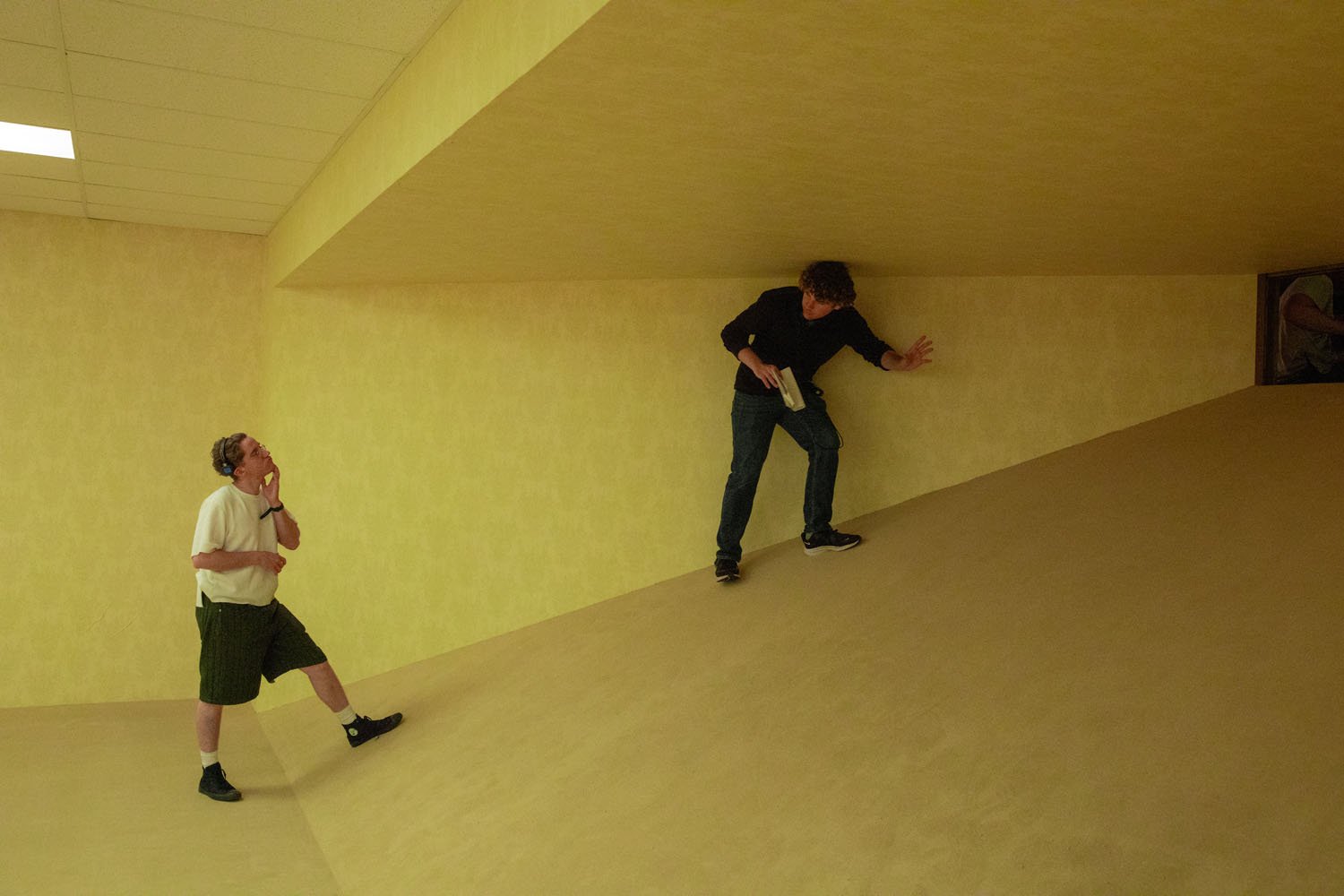
Kane Parsons (right) and actor Finn Bennett on the set of Backrooms
The credits of Backrooms roll to an eerie electronica track called “The Word Becomes Flesh” by Boards of Canada (from their new album Inferno, released the same day as the film, by the way, which has been getting daily spins in my household since release and is sure to rank among the best albums of the year in my eyes). To me, the strongest appeal of Boards of Canada has always been their combination of childlike nostalgia with a deeply analog musical sensibility that makes their music sound like it’s being played back on decaying hardware. A similar ethos can be found in the dark ambient music of The Caretaker, who also gets a notable spot on the Backrooms soundtrack and who constructs his pieces out of samples from ancient jazz records covered in dust and scratches. I definitely see the analog-forward mindset of these musicians as being a core element of Parsons’s film as well, with the most impressive part of the dang thing being that they built those Backrooms!! As Kane Parsons has been smart to point out in interviews, the vast majority of the “impossible” spaces you see in the film are in fact real sets hand-built by real artists — reportedly 30,000 square feet worth of them. Kane Parsons’s insistence on having all this stuff made for real is perhaps the most profound statement made by the film about AI: this is the kind of staggeringly cool art you can make if you let real human artists make it. Why would you want AI slop instead?