
Review by Michael O’Malley
The debut feature film from writer-director Sophy Romvari was a big deal for some Cinematarians, but I’ll admit that I didn’t even know her name before I went to TIFF, much less any of the shorts she built her reputation on. Crucially, I missed the Sophy Romvari train when it swept the cinephile nation a few years ago with 2020’s Still Processing, the short film of hers that, in retrospect, seems to have been an important precedent for her feature. Suffice to say, the only thing I knew about Blue Heron was a list Andrew showed me of films that Romvari said had influenced the feature, and at the moment, the only title I remember from that list now is Terrence Malick’s The Tree of Life. That was enough to pique my interest. I’m not sure if lacking as much context as I did is the ideal way to approach Blue Heron, but it worked for me as I walked into hands-down the most powerful film I saw at the festival.
Blue Heron opens as a naturalistic slice of life focused on a family of six who has just moved to Vancouver Island in British Columbia. The film is largely told through the eyes of the youngest child, eight-year-old Sasha, as she and her three brothers (Felix, Henry, and the much older Jeremy, who is from a previous relationship of their mother’s) explore their new surroundings while the parents (called simply “Mother” and “Father” in the credits) navigate the adult logistics of building a new life. Sasha’s experiences here initially seem to be presenting a bucolic childhood that fits the innocent perspective of someone her age: trips to the beach, unstructured imaginative play, nurturing parents—the patient pace of the film allows for sequences to spool out like nostalgic sensory memories, such as a scene in which Sasha and her mother peel potatoes as the woodwinds of King Crimson’s song “I Talk to the Wind” drift in from the father’s workspace in the next room.
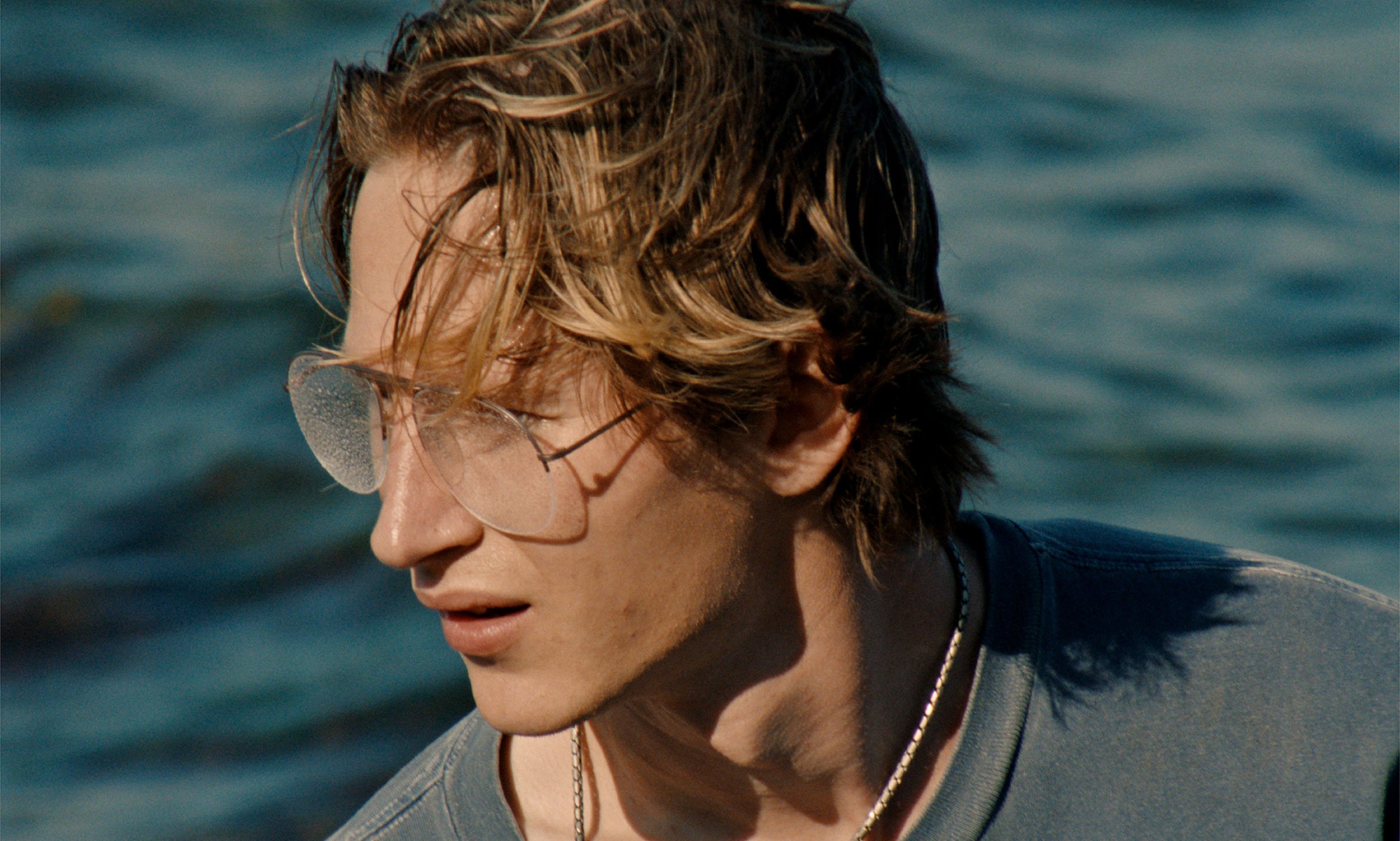
However, soon these gentle textures are complicated by Sasha’s brother Jeremy. He barely speaks and seems in many ways disaffected, even alienated from his family as he gazes inscrutably from behind his large glasses. What might initially scan as teen moodiness or a function of his position within the family (as a half-brother, as an oldest sibling by a wide margin) quickly gives way to something much more troubling, a mix of pointlessly provocative actions like threatening to step on his sister’s sand castle or turning on the light in the father’s darkroom while photos are developing and outright dangerous behavior such as climbing on the roof of the house, breaking windows, and shoplifting. The mother and father are at a loss as to how to handle Jeremy, especially as his behaviors escalate in ways that increasingly endanger himself.
This all unfolds piecemeal through Sasha’s eyes, and child actress Eylul Guven works alongside Romvari’s direction to capture with heartbreaking precision the position a young child finds herself in, building a concept of her family at the same time that that family finds itself tumbling toward freefall. She watches with a mix of seeming naivety about the gravity of the situation and helplessness when that gravity’s pull becomes undeniable. The idyllic tone of some scenes is not exactly a feint; instead, there’s a genuine tension between the good and the difficult. Later in the film, Sasha talks about the confusion she feels about the sweetness of her brother in concert with his harmful behavior that she later becomes more aware of. Her brother is someone capable of creating the sprawling beauty of the fantasy maps that he meticulously drafts across the walls of his bedroom and also acting with the erratic behavior that manifests such anguish in the parents and himself.
This stage of the movie culminates with the involvement of social services, which becomes an inflection point not just in the family’s lives but also in the movie’s structure itself. Suddenly, the film’s narrative jumps forward in time to an adult Sasha, who is in the process of making a documentary film about the childhood events depicted up to that point in the movie. Romvari has been frank about modeling Blue Heron after her own childhood and, in her earlier short Still Processing, transparent about the fact that two of her real-life brothers have died, so although it was a surprise to a Romvari novice like myself, it is probably not a spoiler to reveal that in the adult part of the narrative, Jeremy is dead and that Sasha’s film is on some level an exploration of Jeremy within her memories of her childhood.
Trickier to approach as a reviewer is the much bolder, more mind-bending gambit the film makes in following adult Sasha as she works on the film, not just for spoiler reasons but for the simple fact that what Romvari does reaches for the sublime in a way that’s difficult to fully capture. It would not be fair to frame Blue Heron entirely in relation to The Tree of Life, which is a much different film in several important ways, but Malick’s opus does present a helpful framework for approaching the narrative conceit that’s at the heart of the back half of Blue Heron. In perhaps the most iconic sequence of Malick’s film, the grieving mother of a dead son asks none other than God Almighty: Why? and the narrative of the film cracks open to present us the creation of the universe itself in response. Romvari’s ambitions are decidedly less celestial but no less serious, and Sasha’s filmmaking is rooted in a Why? equally as large as Malick’s.
As in The Tree of Life, a plea to understand a shattering tragedy forms a central pillar of Blue Heron, and also as in The Tree of Life, that plea splits the reality of the film open into a transcendent space that contours the ways that tragedies are, on some level, fundamentally unanswerable on a human scale. Befitting Romvari’s decidedly more terrestrial camera, Adult Sasha doesn’t talk to God; she instead conducts a series of interviews to try to help her flesh out the limited perspective of her childhood memories: she talks to the social worker, she talks to her parents, and in each case, even those who were adults at the time can only offer their own frayed memories and experiences, limited by their humanity and locked in by the passage of time. Even when Sasha breaks free of the limitations of time and interviews Jeremy himself, what is revealed is sparse in terms of factual insight—the diegetic sounds of the conversation fade out as the plaintive notes of Brian Eno’s “An Ending (Ascent)” swell, and we watch brother and sister wordlessly reunited on the beach as the music unfurls.
The Overview Effect is a feeling many astronauts experience when they watch Earth from space, as the sight of our planet overwhelms them with a sense of beauty and connection to other human life. Romvari’s use of the Eno track, originally from the score to the Apollo documentary For All Mankind, recontextualizes that feeling to a position among ourselves rather than among the stars. Like the astronauts who have rocketed themselves thousands of miles into the firmament only to find themselves closer than ever to their Earthbound human peers, Romvari’s film peer across the vast expanse of memory and anguish and even death to cling to one of the people with whom her life began. Perhaps no answer exists to our finitude and pain, but if it does, it’s in the unshakable luminescence of our recollections of lost loved ones as much as it is in Malick’s boundless cosmos.
My own brother died a few years ago; in childhood, he had experienced some of the same struggles that Jeremy does here (though a bit less severely), and his death left my family with a lot of questions that honestly will probably never be answered. Asking Why? of the struggles we had that now are consigned to unanswering memories is something each member of my family has had to practice. My family doesn’t otherwise resemble the family in this film much, but in the ways that matter for the movie, I found a deep kinship with what I saw onscreen, both in the child and adult phases of the film. Blue Heron left me deeply shaken and fundamentally seen in a way that doesn’t often happen to me in movies.
I hope there aren’t many people who share enough of the painful particularities of Romvari’s semi-autobiography here to have the reaction I did, but I also hope that people seek out this beautiful movie regardless. Romvari has done something truly special here.