• Episodes
  • Festival Coverage
  • Video Essays
  • Writing
Menu

Cinematary

where film criticism goes to die
  • Episodes
  • Festival Coverage
  • Video Essays
  • Writing

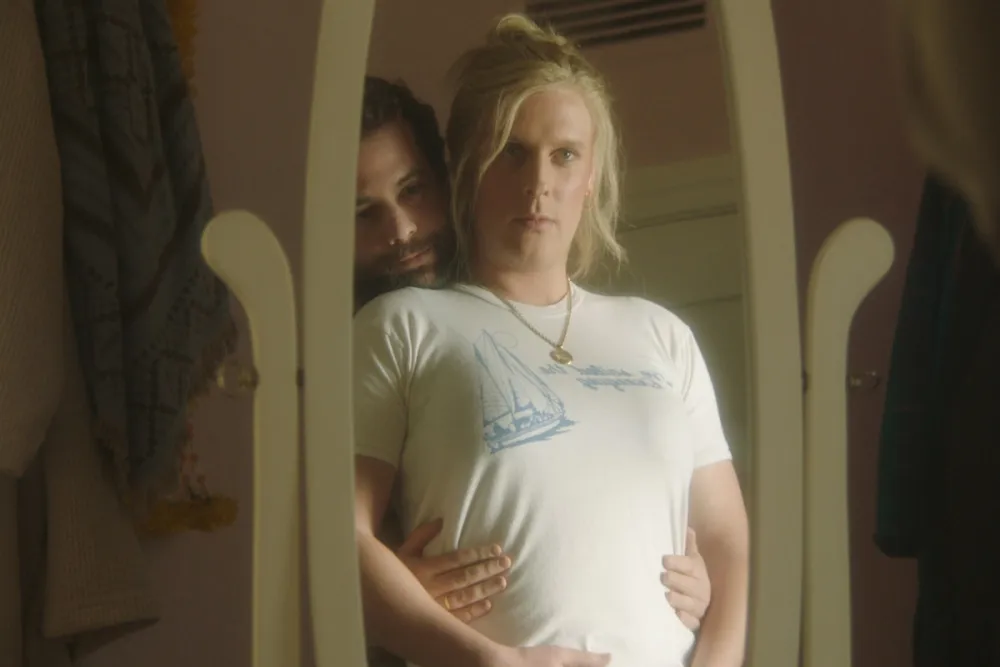
Maddie's Secret (2025) by John Early

January 20, 2026

Review by Grace Winburne

Buzzing with impatient energy, I stand at my assigned spot, lucky number thirteen, and await my turn. My two-ish, maybe five-ish minutes, if I’m lucky, of one-on-one time with various members of the cast and production crew of the movie set to make its world premiere in the next thirty minutes. The movie, Maddie’s Secret, is the directorial debut of SNL alum, John Early.

“Hi, I’m Amelia with Cinematary, a podcast out of Tennessee!” My voice shakes only a little.

“Oh my gosh, I’m from Nashville!” John Early exclaims, with the utmost friendliness and ease.

I’m completely charmed. How exciting to meet a fellow Tennesseean, so far away from home, sharing in conversation about our shared passion for film. How did we get here? What’s the Secret?

TIFF 2025 was a landmark festival overall, but especially so for Cinematary. It’s the first time four of the main panelists/hosts of the podcast were present together. And it was also Cinematary’s first time gaining access to a red carpet. I had the fortunate luck and pleasure to attend my first, and Cinematary’s first press line for the new comedy Maddie’s Secret.

The film follows Maddie, a young woman working at Gormebaby, a food content creation house. Maddie loves food and specializes in vegetarian cooking. When a video of Maddie’s cooking is uploaded to her Instagram, it immediately garners her hundreds of views and likes. From there, Maddie is catapulted into the career stratosphere. She moves up from her dishwasher position and becomes a personality, content creator, and a food influencer for Gormebaby’s thousands of followers. But with the stress of this new job, and Maddie’s appearance constantly under new scrutiny, she begins to fall back on a less than healthy coping mechanism, and her once dormant eating disorder rears its ugly head.

When I received the confirmation email that I had been granted placement, I was absolutely beside myself. Last year, I had applied with no luck to multiple press lines. I was expecting this year to be more of the same. Imagine my surprise, and then my ensuing anxiety! How does one interview actors, producers, and directors about a film they’ve made that hasn’t premiered yet? My answer, or rather, my secret, let them tell you everything they want about the film. I spoke with two executive producers, Ted Schaefer and Hannah Dweck of Dweck Productions, about their involvement with the film.

“We have a very specific taste,” said Ted, “I think people usually come to us when they’re making very specific often strange movies. This was no exception.” Specific and strange are certainly two words I would use to describe this film. For Hannah, she said Dweck Productions came onto this project because they felt like their “interests were so extremely aligned with the director’s.”

I noticed that everyone I spoke with had the same refrain: “It was for John,” or “It’s what John wanted,” and of course, “Anything for John,” and when it was my turn to speak with John, I could see why everyone gave so willingly and freely of their time and talents.

I had exactly one question. In the film, Maddie becomes an influencer, creating food-related content for her followers to consume, all while battling a very serious, and unfortunately, a very out of control eating disorder. While reading the notes on this film, all I could think about was the tension inside Maddie, and how hard it must have been for her to try and pretend that everything is fine and manageable. I started to think that influencing is a sort of acting. That line of thinking gave way to the one question I actually “prepared”. It was for John.

“Where does influencing end, and acting begin?”

We had a bit of conversation and clarification about the question, but John’s insightfulness shone through.

“I think that what’s so funny about influencing is that…because of the rawness of the camera, it inspires this kind of naturalism…and then it’s the very [kind] of fake version of reality. What I mean is, it’s a fake version of realism. Not reality…and I think it’s what inspired this whole movie. It’s a term that I coined, ‘sweater acting’,” from here John’s comedy chops dazzle me as he immediately becomes a character, an influencer, complete with a sweater, or a cardigan of some sort, and finishes by saying “It’s all to look very small and real, and textured. And that was so funny to me, and instead of seeing that on the phone, I wanted to see that in Cinemascope…And that was the experiment. This movie.”

Once I saw the film, I understood the experiment. The “sweater acting” or rather Maddie’s influencing, while not an untrue portrait of Maddie, it is the Maddie she is so desperately trying to be. While the real Maddie, the one she hides from her husband, her friends, her doctors, and her followers, is the true Maddie. Only when she confronts her secret head on and with real kindness and empathy towards herself and her struggles can she actually begin to heal.

This film treats eating disorders with such dignity and respect, offering honest, complicated, and conflicting portrayals of the same disorder manifesting uniquely in each character. There were moments where real facts and figures about anorexia and bulimia were couched in honest conversations about the disorder from qualified medical professionals within the narrative.

Equal parts serious drama, campy after-school special, and comedy, Maddie’s Secret is genuine, kind, funny, and smart! A film so gorgeously and lovingly shot with care and tenderness emanating from every frame.

In Festival Coverage Tags tiff25
Comment

Wake Up Dead Man: A Knives Out Mystery (2025) by Rian Johnson

January 20, 2026

Review by Zach Dennis

If I had to have one complaint about the most recent Knives Out entry, Glass Onion, it would be its need to capture the zeitgeist at all cost.

It didn’t necessarily tarnish the product, but it did date it. Something the first movie avoided while also being able to be aware of its own surroundings. So call Wake Up Dead Man a return to form for Rian Johnson and team, a return to the macabre and autumnal. A dainty Catholic church in the woods of upstate New York and a crisis of faith.

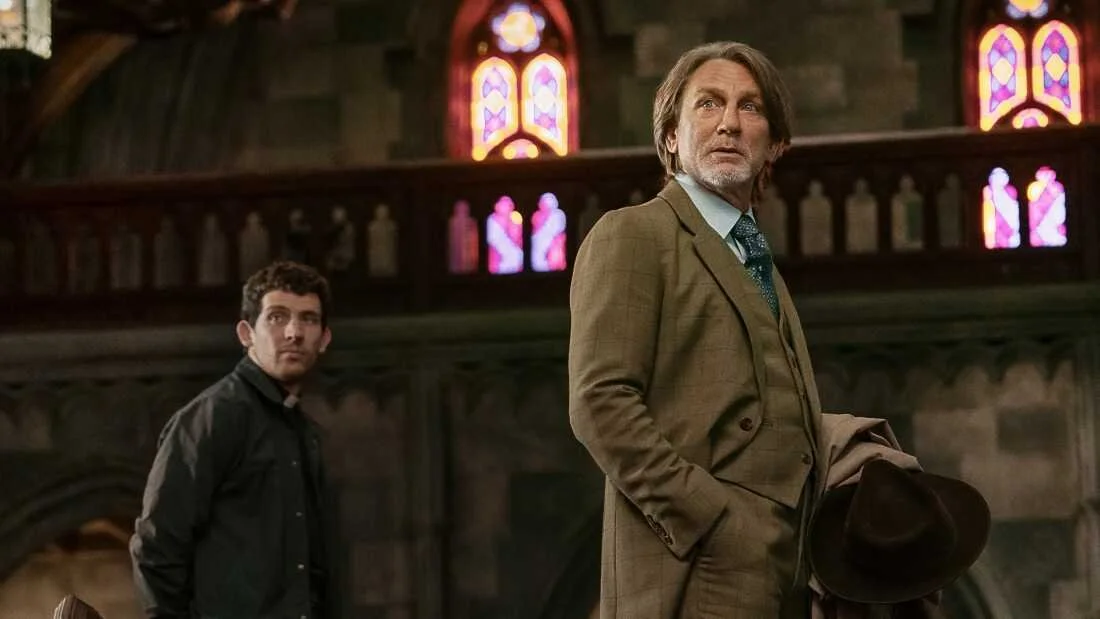
Father Jud (Josh O’Connor) has entered into the service of Monsignor Jefferson Wicks (Josh Brolin), a fire-brand preacher who is more interested in igniting the woke than teaching the word. He has a loyal band of followers: the faithful church servant Martha (Glenn Close); a lawyer whose family is intertwined with Wicks’ work, Vera (Kerry Washington); a depressed and drinking town doctor, Dr. Nat (Jeremy Renner); a long-forgotten writer using the alt-right to get things right named Lee (Andrew Scott); a crippled violin maestro looking to recapture her spark named Simone (Cailee Spaney); and a Charlie Kirk wannabe whose reach feels more like Bari Weiss (or he wishes) named Cy (Daryl McCormack).

Tragedy to the troupe strikes on Good Friday as their beloved preacher passes on from the pulpit, hitting pavement and dying after giving another of his patented sermons. To everyone, the obvious killer is Father Jud but to detective Benoit Blanc (Daniel Craig), there’s more to this lesson.

Craig has so finely tuned Blanc in this third effort that it allows for other cast members to shine. There was a thrill watching the first Knives Out to his Foghorn Leghorn accent that felt out of a Looney Tunes cartoon or an SNL sketch. All of that covered with the facade of James Bond.

Here, Blanc feels more real. Less sketched out. Dropping the pandering cameos and attempts at lore-building from Glass Onion and more of a focus on what makes him the world’s greatest detective. It’s helped by the star-making performance by O’Connor who trades in his eye-catching turn in Challengers for a more conventional role to attract attention from audiences.

Father Jud is the core of the movie with his crisis of faith playing out similar to the plot of the movie: how can we believe things that seem so unreal?

Johnson goes back to the Agatha Christie roots of the first movie, mentioning in a post-film discussion at TIFF that he leaned more on Edgar Allan Poe and his style of horror and mystery for this installment.

It works and his ability to weave the audience along as the mystery unravels makes experiencing a Knives Out movie more of a roller coaster than an exercise in trying to figure out the culprit before the movie leads you there. To that end, let Johnson and Craig’s obsession with Knives Out not end as there aren’t many movies coming out today in multiplexes that are this fun.

In Festival Coverage Tags tiff25
Comment

Sirāt (2025) by Oliver Laxe

January 20, 2026

Reviews by Andrew Swafford and Michael O’Malley

Andrew’s Take:

In the opening scene of Sirāt, we watch and listen to an enormous soundsystem slowly and methodically being plugged up in the middle of the desert, one ka-chunk-ing speaker cable after another. The sun bares down on an otherwise empty expanse, and we at first hear nothing but the idle buzzing of the towering speakers until a wall of ghostly, hypnotic rave music finally emanates forward with glorious volume and heft. The camera floats over through a rapturous crowd of eccentric and bohemian dancers before settling on a man who wanders through the multitude, out of place but clearly moving with purpose. 

The elevator pitch for Sirāt – man searches for his lost daughter across the Moroccan desert rave scene – sounds like a straightforward thriller, albeit an awesome one. But what Óliver Laxe’s film actually is feels more like the kind of eternal wandering through the desert described by the Old Testament prophets. Laxe’s 2019 film Mimosas was almost literally that, following an increasingly small religious sect as they attempt to navigate a treacherous mountain pass with the corpse of their late leader in tow. By the end of that film, a Kierkegaardian “knight of faith” emerges to guide what remains of the caravan, but the characters of Sirāt have no such luck. This is a hellish road to nowhere that offers no happy ending or easy answers – just a sense that things have gone horribly wrong and could get drastically worse at any moment. 

Set in a near-future (or perhaps present) in which an unspecified “war” rages offscreen, the desert offers somewhat of a respite from whatever worse things might be happening in so-called civilization. Although the protagonist initially casts condescending glances towards his raver sherpas, the small community of nomads that make up Sirat’s ensemble cast make for a pretty beautiful found-family of elder goths, disabled folks, and gender-nonconforming misfits. Through continual small acts of care extended to one another, this community offers a briefly utopian vision of a microsociety built upon mutual aid – before that vision is violently destroyed in ways that can’t be predicted and shouldn’t be spoiled. Few films capture the extreme level of fear and tension that so many feel in our ever-uncertain political moment – and even fewer do so with the harrowing intensity that Sirāt does. 


Michael’s Take:

The first movie I saw at TIFF was Óliver Laxe’s newest feature, Sirāt. One of the things that is unique about attending a film festival as opposed to regular moviegoing is your ability to enter a movie in a state of complete naivety. I’m used to going into movies with some ambient knowledge of what I’m in for, whether that be from trailers, reviews, word of mouth, press, etc. In a festival, though, you’re often able to experience a film ahead of all of those things: you see a title, a logline, and a showtime, and that’s typically it, unless you have knowledge of the past work by the director or members of the cast or crew.

It wasn’t strictly true that no information at all existed about Sirāt by the time I saw it; it had already had its world premier at Cannes back in May and a full-on theatrical run in Spain in June before coming to TIFF. However, not having paid attention to the movie’s coverage, all I really had were vague impressions that this was something worth watching, alongside a little input from Cinematary’s Andrew, who had watched a couple of Laxe’s previous features prior to arriving at the festival. Functionally, I went in knowing nothing—poetically appropriate for the first movie I caught at the festival.

That said, writing coverage of the film puts me in the weird place of having to take part in spoiling that sort of green experience, which normally wouldn’t be such a big deal except that the sense of unspoiled naivety is kind of key to the film itself. Sirāt is very heavily staked on certain turns in the film catching an audience completely by surprise, and it’s a little hard to talk about what makes this movie so electric and worth watching without at least alluding to those turns.

The film begins like this: in the Moroccan desert, a roving group of musicians set up amps in isolated parts of the landscape and host raves. The opening salvo of the film is almost entirely free of speech as we watch these musicians assemble their towering speakers against the almost surreally barren rocks and then begin the rave. The music, composed for the film by French producer Kangding Ray, is transportive, and Laxe allows long, unbroken shots of the rave to spool out unhurriedly in a striking intersection of concert film and slow cinema. For as punishing as the environment seems, it’s not hard to get swept up in the mesmerizing euphoric abandon of the crowds.

It seems like a good time. This is the first of the film’s feints, and the only one I’ll spoil completely here; what appears at first to be a kind of low-budget Burning Man-style extravaganza is soon revealed to be a refuge from and maybe even an act of defiance against a political crisis. The film never fully explains the sociopolitical context of its narrative, but allusions to trains of refugees and NATO actions seem to indicate that this isn’t just some localized conflict but perhaps the rumblings of a war of apocalyptic proportions. Accordingly, the musicians seem to be operating a kind of anarchist collective based out of their caravan of vans that they use to cart their equipment from desert locale to desert locale as they elide the military maneuvers occurring around them.

It’s a bit unclear how exactly the crowds who come to these raves know about them to begin with, though they’re apparently a well-enough known entity that word about their events spreads to even normie enclaves destabilized by the war—enter Luis, a middle-aged dad with his young son Esteban and dog Pipa in tow. Luis is a normie if there ever was one, literally buttoned-up (in terms of his shirt), and he finds his way to one of the raves with the sole purpose of trying to locate his missing daughter, who he suspects may have come there, though this seems like something of a hail mary; there are allusions to familial conflict between the daughter and Luis (conflicts never completely sketched out in the film but seemingly rooted in Luis’s disapproval of his daughter’s more libertine proclivities), but it’s apparently the political unrest that has made Luis desperate enough to follow his daughter into the desert. The fact that all he has in tow are his son and dog inside a ramshackle van indicates that more of his life than just his relationship with his daughter may have crumbled, and even though the daughter isn’t at the particular rave, Luis accepts the musicians’ invitation to follow them to their next show in the hopes that his daughter may appear.

The movie speeds up considerably at this point as Laxe switches gears from the slow, hypnotic rhythms of the rave first act into a more straightforward roadtrip film. That initial sense of serenity wasn’t built to last anyway, not in wartime. Once the caravan of musicians, Luis, Esteban, and Pipa begin their journey, the film becomes both much warmer and much more on-edge as the scenes vacillate between the growth of a small community as the travelers bond and the brutality of trekking through a desert with limited resources. Tender moments of budding affection between the musicians and Esteban will suddenly morph into tense struggles to dislodge a stuck vehicle or nervous discussions of water rationing. Imagine a roadtrip in the humanist vein of Almost Famous (albeit not nearly as openly crowd-pleasing as Cameron Crowe’s vision), only with the material threats of something like Mad Max or The Wages of Fear, and you’d have something of an approximation of what to expect—at least for a while.

At a certain point, a moment comes when even that rhythm collapses, and one bottom falls out after another. After that point, the film progressively becomes something even more white-knuckled, hellish, and bleak: the feel-bad thriller of the year, in some ways. This is where the balance of festival writing gets tricker, as the back sequence of the film is the place where the movie fully takes shape while also being something best experienced with no foreknowledge. Without giving too much away about some of the truly shocking turns the film makes, that sense of abrupt disaster is central to what the film is about.

Ultimately, Sirāt is an exploration of the liminal space between freedom and collapse. It’s not exactly positing the classic “freedom vs. security” tradeoff but rather a feeling out of the contours of spaces are created as traditional forms of order and hierarchy fall away. The end of the world as we know it is not the end of the world. A scenario such as Sirāt’s in which the nuclear family has shattered, bourgeois mores have dissolved, and nation states have staggered presents new human possibilities: the rapturous sensory freedom of the rave, the intimacy of a nontraditional found family, the reconfiguration of human life into communities of care.

Sirāt is more apocalyptic than utopian, though. The final act of the movie hinges on the violence of the old systems persisting even as the old systems themselves fall apart in a way that Luis and the musicians seem powerless to escape, and the freer forms of human living that the film captures for the bulk of its runtime seem in the long run to be liminal in the most literal sense of the word, i.e. a threshold. As the film concludes on a desolate but ambiguous note, it seems that the characters who survive have passed completely through this threshold into a new world—not likely a better one, given what they have experienced to get there, but certainly a different one than what has come before. Laxe leaves it unresolved what these survivors will take from their liminal moment of freedom into this new age, which I suppose is a question for our current world, too, as we experience the bubbles of human connection within a broader context roiling with violence, ecological devastation, and displacement. These moments of beauty come and go, and then all that remains are the memories and the imprint left on our spirit. What then?

I hope that’s enough to whet an appetite for the movie without spoiling it. I imagine that many audiences will find themselves restless at Sirāt’s languorous beginning, but those who stick around find a film that’s anything but.

In Festival Coverage Tags tiff25
Comment

Sentimental Value (2025) by Joachim Trier

January 20, 2026

Reviews by Zach Dennis and Michael O’Malley

Zach’s Take:

There’s something sacred about the home.

Not that thrown together, quick builds we mostly see today but a home built with wood, brick, stone; it creaks and bends, almost falling apart by each step. But it’s also warm and inviting, there feels like history born within its bones.

It helps in Sentimental Value that the family home feels almost like a cathedral. It almost feels inhabited by ghosts – memories from far off, both good and bad. Etches in the walls signify milestones in life and secret compartments and devices make it magical.

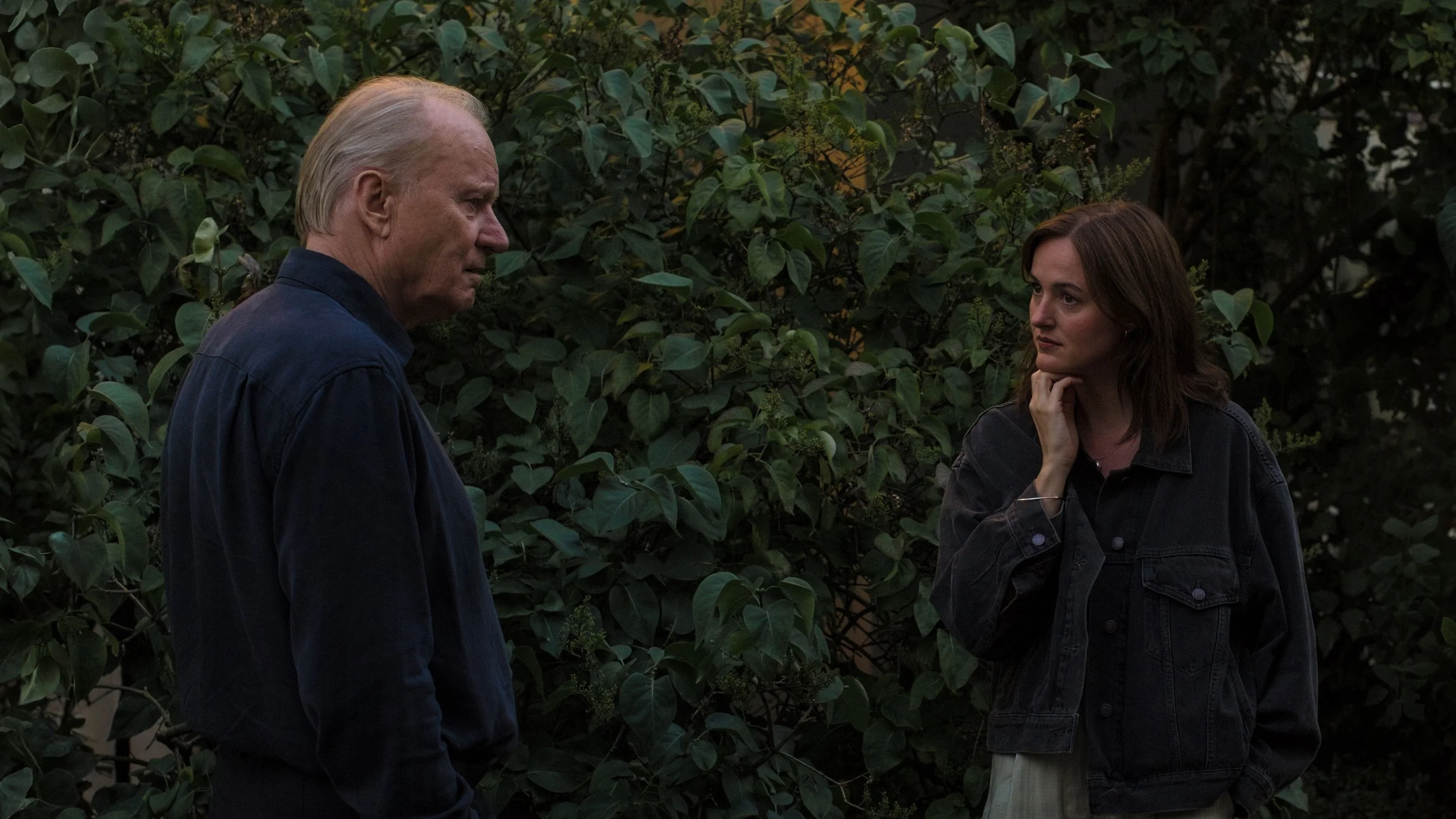
But that’s all lost and flowery now for sisters Nora (Renate Reinsve) and Agnes (Inga Ibsdotter Lilleaas) as they return to their childhood home due to the loss of their mother. After separating with their father, she kept the home for decades but it’s clear that both girls recall more memories of them together than separate.

Their father returns. Gustav Borg (Stellan Skarsgård) ran from the home before, chasing a film career that earned him acclaim but has left him dry over the past decade. He has a new project though and he’s back in Oslo to pay his respects to his late ex-wife, but also to speak with Nora, who has become a renowned theater actor locally.

Borg has a history of bringing his familial life into his work. Agnes was the star of a previous film and he speaks emphatically about the experience he had working with his daughter. Nora doesn’t feel the same. The relationship is different now and she resents her father for choosing work over his children. She rejects his script and he’s at zero again.

While in Europe to receive a lifetime achievement award and reflect on his career, he happens upon a burgeoning American starlet named Rachel Kemp (Elle Fanning) who sees Borg’s film that starred Agnes at the retrospective and becomes inspired to meet and work with him. Taking over the role that was destined for his daughter, and with the help of funding from Netflix, Borg sets out to begin his film with the family’s old home serving as the set.

The most familiar film for many filmgoers today from writer/director Joachim Trier is probably The Worst Person in the World, a true international hit that starred Reinsve in the lead role. As a fan of Worst Person, this film feels much richer and moving than the portrait of a 30-something trying to get her life together. If anything, Nora feels more disjointed than Julie in the earlier film.

In this role, Nora is depressed but lacking the clarity to name it that and coasting through life with casual sex with a fellow cast member and putting her total focus into her next acting project. She’s not aware that she is actively crumbling, attempting to creak and bend like the texture of her childhood home but instead leaving a space for a big break.

There is something hypnotic about Reinsve in the film. She drops the unbridled confidence of Worst Person for a person putting on the mask of assurance with the face of fear. A scene late in the film where Rachel contacts and meets with Nora in an attempt to try and understand how to handle the role that she has accepted falls into this attempt to understand a person that doesn’t fully understand themselves.

It isn’t until Agnes sits with her sister and allows her to read her father’s script that she begins to unlock what is ailing her; brought to tears by the fact that her distant father can comprehend the depths of her grief and sadness more than she could in her own soul.

There’s a melancholy to Sentimental Value but also a comfort. You see history play out within the walls of the home where joy, pain, death and grief overcome the space. Maybe it is too much and maybe there is a time that we just have to let go.

Sentimental Value doesn’t provide that answer, but poses that there might be a path forward in forgiveness and the decision to move on.


Michael’s Take:

I never got around to The Worst Person in the World, Joachim Trier’s previous feature, but his new film, Sentimental Value, has the feel of a victory lap. That previous film garnered Trier the most accolades of his career, including Best International Feature and (alongside Trier’s longtime writing partner, Eskil Vogt) Best Original Screenplay nominations at the 2022 Academy Awards. So here’s Sentimental Value: another Vogt/Trier screenplay, and Trier seems to have leveraged his rising profile to make a lush production featuring international stars like Elle Fanning and Stellan Skarsgård alongside his typical stable of actors such as Renate Reinsve and Anders Danielsen Lie—the highest-profile cast of any of his films since 2015’s Louder Than Bombs.

In that context, it’s hard to miss the irony of Sentimental Value’s premise, which focuses on a washed-up filmmaker (Skarsgård) whose days of prestige and industry clout are so far behind him that he struggles to get funding for even modest films, and whose unlikely partnership with a rising American starlet Rachel Kemp (Fanning) is a career Hail Mary formed more out of a last creative gasp than any contemporary relevance. The filmmaker, Gustav Borg, has no illusions about where his career is; throughout Sentimental Value, his character is transparent about his industry struggles, and for as much as he pitches his prospective new film to financiers as a comeback (buoyed by Kemp’s marketability), there’s a palpable sense that it will instead be a swan song.

Rachel Kemp is not actually Gustav’s first choice, though: that distinction goes to his daughter Nora, who is an actress in the midst of her own career struggle as, despite her success, she navigates unexpected waves of stage fright. Nora (played by The Worst Person in the World’s Renate Reinsve) flatly refuses Gustav’s proposition, and not just because of her recent acting troubles. Gustav and Nora’s mother, Sissel, divorced when she was a child, leaving Sissel to raise Nora and her sister Agnes (Inga Ibsdotter Lilleaas) alone while he focused on his career. He has only been intermittently present in his daughters’ lives since, and, now adults, Agnes and especially Nora are estranged from their father. On top of that is the timing: Gustav arrives with his casting proposition in the wake of Sissel’s death, which has, among other things, given Gustav control over the generational family home where he intends to use for the central filming location of his new movie, and while Gustav talks about his film as a chance to reconnect with his daughters, Nora sees the endeavor as rank opportunism from a man who has often treated his family as an accessory to his career. The fact that Gustav’s prospective film is a deeply personal one based on the life of his mother, who committed suicide when Gustav was young, further complicates the issue of whether he is using his film to reconcile with his family or using his family to advance his film.

The film takes Nora’s feelings about her father seriously, but one gets the sense that Trier and Vogt don’t inherently disapprove of the idea of using family history as artistic inspiration. There are echoes of Trier’s own family history here, most obviously his grandfather, Erik Løchen, who was a celebrated Norwegian filmmaker, and Trier peppers the film with small connections to him, such as Gustav’s mother, like Løchen, having been a part of the resistance to Nazi occupation during WWII. In Sentimental Value, filmmaking becomes an invitation for Gustav, like Trier, to ruminate on the threads of his family’s history, and for whatever murky motives and past hurts from Gustav, that act of rumination is productive.

The obvious film canon precedent to all of this (which Trier has openly acknowledged in interviews) is Ingmar Bergman’s 1957 classic Wild Strawberries, about an aging man whose last name is also Borg taking stock of his life on the precipice of a career shift. Trier has a much less metaphysical sensibility than Bergman has (and also a less Nazi-sympathizing one, as Skarsgård has been vocal in reminding people over the past few years); whereas Wild Strawberries’s protagonist finds himself spanning time and space to walk into his own childhood, Sentimental Value instead uses occasional montages that pivot the narrative into the past. That’s perhaps a less brain-bending device than Bergman’s, but these digressions are nonetheless lovely as they pirouette through not just Borg’s own history but also those of other generations who have lived in the house: his grandmother’s, his mother’s, his ex-wife’s, his daughters’.

In fact, for as much as the Wild Strawberries connections present themselves, Trier and Vogt’s screenplay is decidedly more interested in the women in Borg’s life than Bergman’s is. The film opens with one of its historical montages, one that centers not Gustav but Nora and an essay she wrote for school around the time of her parents’ divorce, about the family house to be turned into a film set. The film is full of notes like these that entirely cede the perspective to those outside of Gustav’s own narratives; another occurs when it is Agnes, not Gustav (despite his overtures about plumbing the depths of his matriarchs’ histories), who ends up researching the lives of her grandmother and great-grandmother in a historical archive. Gustav may play the part of the lonely genius, but the film is insistent in puncturing that iconoclasm with the presence of other characters offered as much richness in detail by the movie’s narrative as he is.

The result is a warm ensemble film that finds its weight not in Bergman’s intense, even hermetic interiority but in a collectively shared space. Gustav’s new film has perhaps not righted all the wrongs of the past nor found complete peace with the tides of history, but the people who have participated at least find themselves a step closer toward reconciliation. Film is one of the most collaborative of mediums, and while Trier/Vogt would never be so corny as to suggest an overt healing in Movie Magic, Sentimental Value does find a restorative power in the filmmaking process’s ability to bring people together.

It’s a wonderful movie, one of my favorites of the festival, and I’m excited to see others encounter it.

In Festival Coverage Tags tiff25
Comment

Sacrifice (2025) by Romain Gavras

January 20, 2026

Review by Andrew Swafford

“Mother, the volcano spoke to me this morning. The old way must burn to ash for the new way to be born.” These lines, presented in whispered voiceover by Anya Taylor-Joy, set the tone for Romain Gavras’s Sacrifice – strange and portentious, but also just a nudge over the line into outright camp.

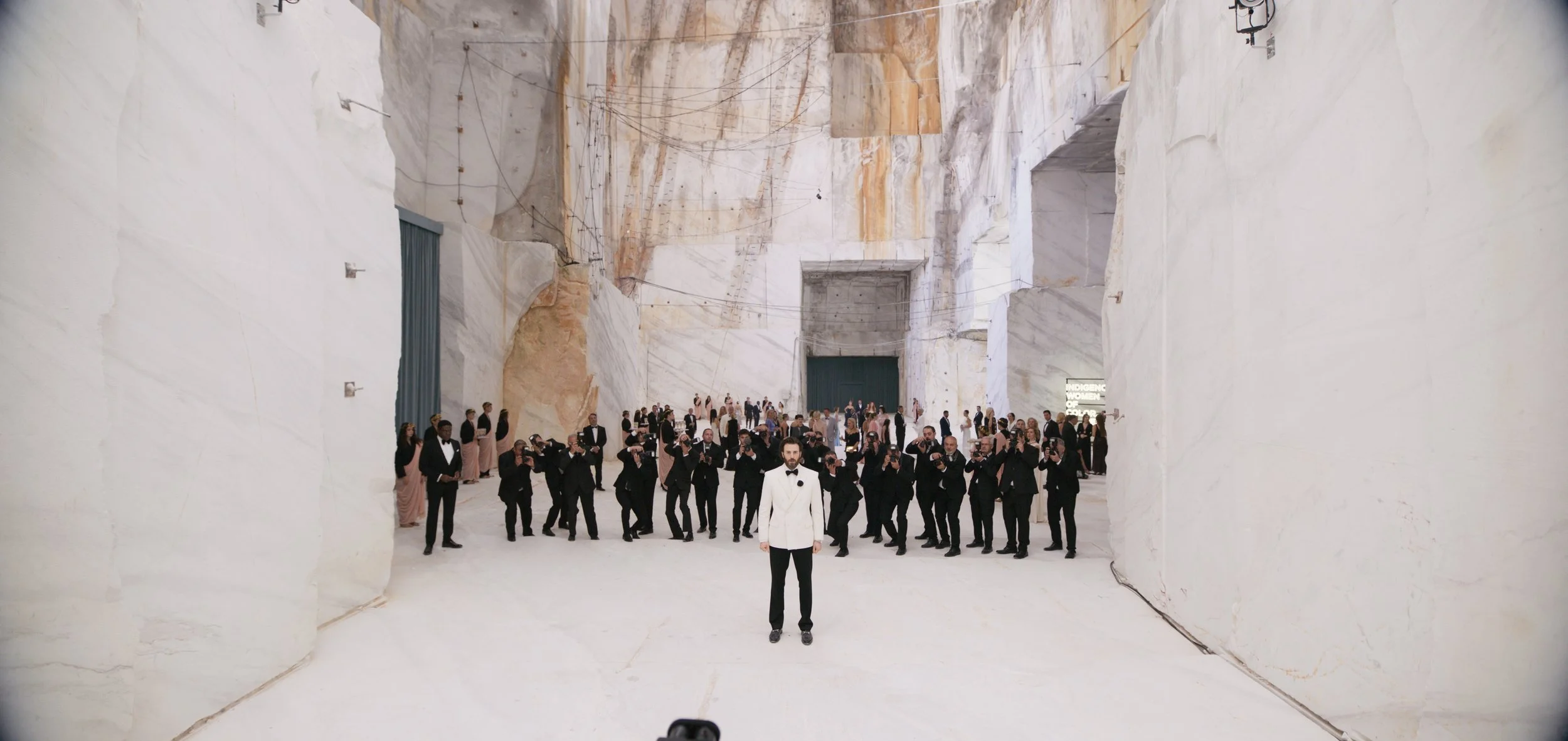
Starring Chris Evans as a recently disgraced A-lister attending a star-studded gala fundraiser for a supposedly environmentalist enterprise being undertaken by the world’s richest man (Vincent Cassel), Sacrifice is an interrogation of self-serving climate change “activism” as it is commonly practiced by the ultra-rich. Cassel’s plan to fight climate change – some sort of underwater fracking operation – seems like it’s both actively destructive and a naked attempt to lay monopolistic claim to an untapped natural resource. Chris Evans sees through this, but only performatively speaks out against it when he knows there’s a camera running to capture a sure-to-be viral moment. After a ridiculous musical interlude provided by none other than the great Charli XCX, the gala is brought to a screeching halt by Anya Taylor-Joy, here playing a radical militant who wants to throw all these people in a volcano.

This is the setup for Romain Gavras’s Sacrifice, the latest film in a long line of so-called “Eat the Rich” movies that have been ironically all-the-rage in Hollywood since the undeniable success of Parasite. From The Menu to Glass Onion to Ready or Not among so many others, the Hollywood elite has been really interested in pandering to people’s distaste for conspicuous consumption at a moment in history where wealth inequality seems to be outdoing that of the Gilded Age. It’s hard to know to what extent this push for anti-rich agitprop is sincere on the part of genuinely disillusioned screenwriters and to what extent this is simply recuperation, the defanging of previously radical ideas. Nevertheless, it is interesting that Sacrifice is taking this particular tension between ostensible activism and celebrity status as its primary focus.

Taking a voguish subtext and making it text, however, is a double-edge sword, as the central metaphor animating Sacrifice is hardly a metaphor at all. Yes, it will take sacrifice on the part of the ultra-wealthy in order for us to make meaningful progress towards combating the already-ongoing climate apocalypse. Taking that premise and centering it on the well-trod Appease the Volcano God trope doesn’t feel all that inspired, as fun as the trope can be. 

If there’s unexpected depth to be found in Sacrifice, it is probably to be found in some third-act revelations about Anya Taylor-Joy’s character that I shouldn’t spoil here – especially since the movie hasn’t even found a distributor yet. I look forward to reading the inevitable analyses of this when the film becomes widely available, which I suspect it will and ultimately think it should. Suffice it to say that there is another layer of what’s going on here, explained quite literally by a late-arriving character played by John Malkovich. The knowledge he shares reframes the way the audience looks at Anya Taylor-Joy’s character, revealing her to be even more of a total weirdo than she already seemed. 

And at the end of the day, that’s what I’m most appreciative of Sacrifice for doing: not taking some brave stance about climate change or making a self-reflexive dig at celebrity culture, but simply giving Anya Taylor-Joy a new kind of weirdo to play. She is fantastic at it. 

In Festival Coverage Tags tiff25
Comment

Roofman (2025) by Derek Cianfrance

January 20, 2026

Review by Andrew Swafford

When I walked out of the Roofman premiere at TIFF, my main thought was that it would be perfect for a release over the Christmas holidays: not only does the climactic stretch of the film take place at Christmas, but it also has a crowdpleasing family-movie vibe (some light R-rated content notwithstanding) that made me eager to show it to my mom. The film’s distributor, Paramount, elected instead to release it theatrically in early October, but after watching it over some random streaming service with my family on Christmas morning, I maintain that I was right: it made for perfect holiday viewing, and mom raved about Roofman for days. That’s worth more than any critical analysis I could offer here, I think.

Nevertheless, my role as a critic beckons: Roofman is a lighthearted true-crime story set in the late-90s about a broke, divorced, exmilitary dad named Jeffrey Manchester. Played here by Channing Tatum with all the star’s usual charming charisma and playful physicality, Manchester attempts to provide for his daughter by robbing dozens of McDonald’s restaurants, cutting holes in the roof to make his trademark entrance. He is quickly caught and imprisoned, but he leverages his Special Forces training to break out and take refuge in an unnoticed alcove of a Toys R Us (managed by a delightfully callous Peter Dinklage), where he lives undetected for months. This would all be wacky enough without the added element of his falling in love with one of the store employees, even going so far as to become part of her church community and serve as a temporary father figure for her two adolescent daughters. His love-interest, Leigh Moore, is played excellently by the always-wonderful Kirsten Dunst, who brings a fully believable, down-to-earth seriousness to her role as a southern single mom. 

The story here is pretty much all what really happened, as the end credits montage of real-life footage attests – and it’s a fun change-of-pace for the true crime genre, which is generally defined by ultra-gory stories of prurient sexual predation. Adding to the sense of authenticity here is the fact that the film features many non-actors playing themselves, and it was all shot in the story’s actual location of Charlotte, North Carolina, where Cinematary’s own Zach Dennis covered the story of the film’s release on several different occasions for The Charlotte Observer. With this in mind, it’s a surprisingly respectful look at the everyday lives of lower-middle-class southerners, who are all too often defined by the most hateful and bigoted among us. That bigotry certainly exists in the south (as it does everywhere), but what this movie captures so well is that most southerners are just kind-hearted folks struggling to get by. 

One of the real-life details unfortunately left out of the story, however, is that Manchester eventually moved locations from his sanctuary in Toys R Us to a nearby Circuit City, which I think would have been a fantastic inclusion. Not only would such a tech-heavy locale allow us to see Manchester pull off more delightful feats of screwball engineering (like using baby monitors to set up his own set of closed circuit security cameras), but it would also bring into even clearer focus the backdrop of economic precarity that gives this film a sense of depth. Like Toys R Us and Blockbuster Video (which gets a tragically passing glance at one point in the film), Circuit City is one of many corporate franchises to not survive into our current era of scorched earth hypercapitalism. If they can’t make it, what hope is there for the downwardly mobile people who populate the world of this film? Kirsten Dunst’s character has a Master’s Degree, and yet she works at a Toys R Us; Channing Tatum was a highly valued Special Forces operative, and yet the opening scene sees him stealing from McDonald’s so that he can afford to buy his daughter the bike she wants from her birthday. 

Looked at from this vantage point, the film seems like it might be a dour affair – but that couldn’t be further from the truth. Roofman is frothy and fun, with snappy pacing and extremely likeable characters brought to life by fantastic performers you already know and love. It is, again, a movie you can watch with your mom. I think the breeziness of the viewing experience has led to most critics being fairly tepid in their praise of Roofman, but personally, I don’t see why we shouldn’t praise a movie for simply being a very good version of what it is: in this case, a goofy true-crime caper with broad appeal. It’s not the most challenging or innovative film I saw at the festival by any stretch of the imagination, but in a film landscape that is increasingly being hollowed out by the same market forces that swallowed up Toys R Us, I think we need plenty of well-made movies like this too

In Festival Coverage Tags tiff25
Comment

No Other Choice (2025) by Park Chan-Wook

January 20, 2026

Review by Michael O’Malley

When No Other Choice opens, Yoo Man-su is on top: he’s got a house, a beautiful wife, two children, two very good dogs, and a 25-year career at a paper factory. He’s especially gratified with that career, where he takes deep pride in the gargantuan rolls of paper that spool from the machines, to the point where he scorns the internet because of its lack of paper usage. He even won the prestigious Pulp Man of the Year in 2019—as one character assures us, they don’t give Pulp Man of the Year to any old fool. In short, Man-su says it himself: “I’ve got it all.”

Longtime viewers of the films of director Park Chan-wook may at first find themselves waiting for the bottom to fall out within this comically thick bourgeois bliss. Park didn’t make his name as a chronicler of contentment, after all; this is the man who brought us the cruel ironies and brutal violence of his early-2000s Vengeance Trilogy and the twisty murder plots of 2022’s Decision to Leave. Sure enough, No Other Choice soon delivers the punchline: without warning, Man-su is fired. Upon finding himself in professional freefall, Man-su flails as he tries to claw his way back to the managerial stability he built his life around, but an increasingly cutthroat job market leads Man-su to turn to increasingly drastic measures to find another job in his beloved paper industry. Where exactly the film goes from there is probably best left unspoiled, but suffice to say: irony, violence, and, yes, murder yet again find their way into a Park Chan-wook film.

A new film by Park Chan-wook is an event—for what it’s worth, the only two TIFF screenings I got to that filled up before I could get a seat were the new Knives Out movie and No Other Choice (thankfully, I caught a surprise extra screening of the latter, hence this review). While certainly those two won’t find the same magnitude of audience (I don’t see Park getting multi-film Netflix deals), No Other Choice was probably the highest profile film I saw at TIFF, and it was exciting to be able to do what I’ve seen critics do my whole life, i.e. get an early peak at a widely anticipated new work by a master and anticipate wider audience reactions.

More exciting still is that, at least among his feature films (I haven’t seen his two recent English-language miniseries), No Other Choice feels like something new for Park in two particular ways. First of all, while Park is certainly no stranger to black comedy, No Other Choice is a noticeable step further into overtly comic territory than any Park film I’ve seen. Paper-themed jokes abound, and a lot of the dialogue has an absurd, almost farcical edge to it: such as when Man-su’s family laments, as if it were tantamount to visiting a bread line, that they will have to cancel Netflix now that Man-su is out of work. Even more ostentatious is the film’s use of physical comedy. Several sequences involving Man-su’s job-hunting schemes evolve into full-on slapstick setpieces, pratfalls and all. The grim edge that has often characterized Park films is still there (one notable slapstick scene involves a would-be assassin struggling over weapons with a would-be victim), but tonally, No Other Choice winds up in a place that makes it seem as though Park has been taking notes from fellow Korean auteur Bong Joon Ho, whose films often lace broad comic buffoonery into otherwise serious proceedings.

Park may have been looking to Bong for thematic ground as well, which brings me to the second way this movie presents something new for Park. It’s not as if Park’s movies have never carried political implications (the gender and sexual politics of The Handmaiden come to mind), but No Other Choice feels like the film of his that most directly confronts the contradictions of neoliberal capitalism. The film’s title is first spoken in dialogue during the scene in which Man-su is laid off, when the corporate suits that bring him the news say that the competitive paper market leaves them “no other choice” than to downsize, and the phrase crops up a number of times throughout the movie, each when a character must justify harmful behavior to gain an edge within a competitive world. Under the structures of unfettered market forces, it’s either kill or be killed (sometimes literally).

It’s worth mentioning that the movie is an adaptation of the 1997 Donald Westlake novel The Ax, which itself was inspired by the ’80s/’90s wave of corporate belt-tightening following the Reagan/Thatcher market liberalizations; Thatcher, of course, famously said that “there is no alternative” to capitalism, and with a few thesaurus flips, that slogan could just as easily be worded as “no other choice.”

An understandable fatigue has set in among some audiences regarding the “eat the rich” type of film that has become fashionable in the wake of the Oscar victory of Bong Joon Ho’s Parasite, which No Other Choice may at a cursory glance resemble. However, the masculine middle-class precarity of its plot and the ’90s source material actually positions Park’s film within that decade’s wave of downwardly mobile “angry man” cinema of the likes of Falling Down or American Beauty—maybe an even more ignominious tradition for contemporary audiences than the plug-and-play “eat the rich” sentiments.

But the injection of Bong-style slapstick into a ’90s-style plot of masculine desperation is a savvy move. No Other Choice turns the reactionary tendencies of its ’90s precedents into a wicked farce, not just of the power fantasies of Man-su’s class but of the very idea of the market logic undergirding his actions. By the time we actually see the job that all this competition is striving for—a lonely post monitoring self-operating machines in a mausoleum-like factory—it’s a bitter joke at the expense of the men who have fought tooth and nail against each other to grovel at the feet of capitalism’s rational conclusion: a world completely automated, competition literally dead.

This was one of my favorites from the festival, and I hope people seek it out when it hits theaters.

In Festival Coverage Tags tiff25
Comment

The Mysterious Gaze of the Flamingo (2025) by Diego Céspedes

January 20, 2026

Review by Grace Winburne

From the directorial debut of Diego Céspedes comes an absurdist, surrealist, Western fairytale about a little girl, and the family of Transwomen in the small Chilean mining town who raise her. We follow Lidia, an eleven year old girl, who lives in the only bar/cantina/club in the small, mountain village. This bar is owned by matriarch Mama Boa, an elder transwoman. Living and working at the bar are all her daughters, self-described transvestite women: Eagle, Lioness, Estrella, and Lidia’s mother, Flamingo. Set in 1982, there is an added historical lens through which we view and contextualize Queer identity and romance, where sex and violence are inextricably linked. There is a plague that is decimating the town. This plague is believed to be transmitted via the eyes, with a single look. The men in the village, and it seems to be populated solely by men, believe that the women, Mama Boa and her daughters, are the reason and carriers for this plague. The men cover their eyes to protect themselves from the plague by day, but by night, the men join in the fun at the cantina where the women are singers, dancers, performers, and for some, their lovers. Only at night can the men of the town find love and acceptance for the women, while during the day they are targets of hate, ignorance, homophobia, transphobia, and violence.

The film is told from Lidia’s perspective, and she spends much of the movie trying to solve this mystery. What is the plague? As Lidia discovers, it is a sickness, an all-consuming sickness that turns men angry, confused, and scared before eventually killing them. It is a sickness that turns her aunts and mother weak and tired, that makes them thin and frail. Where does it come from? It comes from a single loving look, transmitted via the eyes. And why do people die from it? This remains a mystery to Lidia.

Tragic, haunting, romantic, and tender, I was immediately endeared by the powerful and beautiful Transwomen who create a family for themselves. They are an oasis of queer identity, joy, and love in the middle of a barren desertscape. They care for each other, protect each other, love each other, and celebrate each other. They are sisters, proud and defiant, brought together under the love of their Mama Boa. The family protects themselves when the young boys in town bully Lidia. Flamingo and Lidia’s tias, rough up and scare those boys within an inch of their lives. When the family suffers heartbreaking tragedy, they put themselves back together and continue to love stronger than ever. As Lidia grows, Mama Boa teaches her how to defend herself, showing Lidia how to throw punches and to always aim below the belt when fighting a man. Excellent life advice.

The empathy and kindness with which the characters and their stories are treated felt so fresh and new. We’ve seen films with various good and bad depictions of Transness, Queer joy, and plenty of Queer violence, but disguising it all as a “fairytale” told from a child’s perspective takes some of the sting out and makes everything more beautiful. Mysterious Gaze of the Flamingo was awarded Prize Un Certain Regard, at Cannes 2025, and was the Best of the Fest for me, two very prestigious awards.

In Festival Coverage Tags tiff25
Comment

Miroirs, No. 3 (2025) by Christian Petzold

January 20, 2026

Review by Michael O’Malley

To say that an artist has repeated themselves is often thrown out as a criticism, but one thing that can be nice about getting to know an artist’s body of work is the feeling of comfort as the rhythms and tropes of the artist become familiar. At least, that’s how I felt watching Christian Petzold’s Miroirs No. 3. Whereas Petzold’s last couple films, Undine and Afire, respectively pushed toward more arcane and more satirical territories than his previous work, Miroirs No. 3 finds him settling back into thematic and narrative patterns that have spanned the German auteur’s filmography.

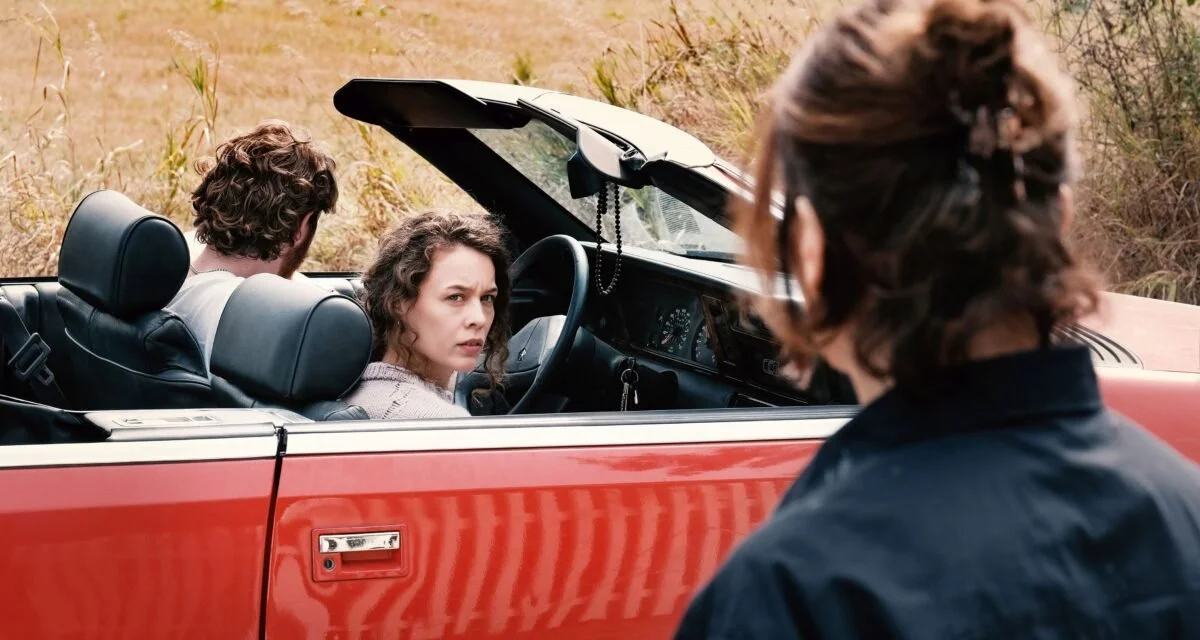
The plot is this: Laura (Paula Beer), a pianist studying music at a university in Berlin, is on her way to a weekend outing in the country with her boyfriend Jakob when she decides that she doesn’t actually want to go. In fact, she seems increasingly dissatisfied with her life in general: anxious about her studies and maybe even considering breaking off her relationship with Jakob, with whom things seem to have been tense recently. Before anything of the sort comes to a head, though, fate intervenes when on the drive back from the aborted outing, the couple get into a car wreck that kills Jakob. The paramedic suggests that Laura come with him to the hospital to be checked out for injuries, but, perhaps seeing a chance to delay a return to an already uneasy life that will now also be haunted by a deceased loved one, Laura makes a strange request: to recover by staying at the rustic cottage of the local woman (Barbara Auer) who first arrived at the scene of the accident. This woman’s name is Betty, an aging woman seemingly living by herself, and for reasons even more opaque than Laura’s, she agrees to host this perfect stranger.

The bulk of Miroirs No. 3 unfolds at Betty’s cottage as both Laura and we viewers learn more about Betty and her motivations for welcoming Laura so easily. Fairly early on, it becomes clear that Betty isn’t living entirely on her own; just a short bike ride away live her husband Richard (Matthias Brandt) and adult son Max (Enno Trebs), who run a garage that, among other things, turns off GPS tracking for cars (possibly an echo of the political anxieties of Petzold’s Transit, though just as likely a mere tool for philandering men). Both men seem somewhat estranged from Betty but not enough to avoid checking in on her. The family has apparently weathered tragedy in the not too distant past, a tragedy that seems to have at some point precipitated mental health instabilities in Betty.

A lot of this is familiar ground for Petzold. The use of doubles in the plot and characters remains a Petzold trope, and calling this one “Mirrors Number 3” (besides referencing the Maurice Ravel piano piece that Beer’s character plays) seems like it could be a sly acknowledgement of just how many of his films could justifiably have shared that title. Furthermore, the haunting of the present by past tragedy recalls Phoenix and Undine, and the echoing of plots from iconic classic Hollywood films is a well Petzold returns to again and again—Jerichow’s The Postman Always Rings Twice, Transit’s Casablanca, Phoenix’s Vertigo, and now Miroirs’s Rebecca and, well, Vertigo again. Even the faces of the characters themselves should ring bells; most of the cast (including all of the central four performers) has played in multiple Petzold films in the past, and specifically Paula Beer has become something of a muse for Petzold since Transit.

And it’s nice! Petzold is good at what he does, and this film is no exception, even if perhaps a bit too much of it is banked on waiting on the other shoe to drop in a mystery that is ultimately not all that surprising, especially for anyone familiar with Vertigo and Rebecca. I get the impression that shocking revelations weren’t really the intent here, and the dark, twisty undercurrents of those Hitchcock precedents are ultimately something of a feint. Nor does the film seem particularly interested in the Bergman-esque psychological gauntlet initially teased by the isolated country setting haunted by death and family drama.

In fact, the most surprising thing about the movie is that it ends up being rather sweet. While the uneasy obsessions and ghostly premonitions of Miroirs’s cinematic influences aren’t entirely absent from the film, the shape the movie eventually takes is one of progress through those darknesses. The liminal arrangement between Laura and Betty ultimately fractures in the ways you might guess of a situation premised on being a proxy for deferred past traumas and present insecurities; yet despite that fracturing, the movie ends on a coda that seems to show the characters better off than when the movie began.

Arguably, there’s a certain ambiguity about how sincerely we’re supposed to take this: the fact that “better off” involves putting each character back in their socially designated “right place” (whether that be the reinstatement of a nuclear family unit or the return to a bourgeois stability) makes the ending remarkably pat in a way that raises questions of how much these characters are actually happier versus simply parroting the social scripts within the roles expected of them. But I’m actually inclined to take the ending at face value, not as a neutralization of the thornier premise but an affirmation of it. The ultimate structures that govern our lives may be beyond our control, but imagining radical reconfigurations of our lives is an important part of finding peace within those structures.

I can see others finding this to be an instance of an auteur’s work losing its teeth, but I dunno, even the world of austere European arthouse cinema deserves happiness every once in a while, right?

In Festival Coverage Tags tiff25
Comment

Hamnet (2025) by Chloe Zhao

January 20, 2026

Review by Andrew Swafford

Full disclosure: I haven’t read the novel that Chloé Zhao’s Hamnet is based on (I hear it’s excellent), but I have taught Shakespeare on the high-school level for about a dozen years, and even taught a class entirely dedicated to him for three of those. In all the research I’ve done about the man and his work over the years, the main thing I’ve learned is that we know almost nothing about Shakespeare. We have the plays, of course, but other than that, what scant information we have about the man himself is scattered across a relatively small number of legal documents, upon which his name is scrawled in over 80 different spellings – his “real” name might as well be “Shagspere,” for all we know. 

This slipperyness of spelling is something the film draws attention to by only ever referring to Shakespeare’s wife as “Agnes” rather than the far more commonly recognized “Anne Hathaway.” With this in mind, it becomes all the more interesting that the title of Shakespeare’s acclaimed tragedy Hamlet shares a striking similarity to the name of his son Hamnet, who died at the tender age of 11. Due to the lack of linguistic standardization in Renaissance England, “Hamlet” and “Hamnet” might as well be the same name. Surely there’s more to this connection between the ill-fated Prince of Denmark and Shakespeare’s own late son, an untold story waiting to be either uncovered or artistically imagined. What could it be?

Chloé Zhao’s Hamnet boldly posits: he was sad. I hate to be crass about a movie that left what seemed like my entire TIFF theater in an emotional wreck, a movie that won TIFF’s People’s Choice award, a movie that is considered a frontrunner for Best Picture at the Oscars this year, and a movie that Focus Features has marketed with a verifiably bogus quote calling it “the greatest film ever made” – but as an independent critic, I feel a certain amount of duty to be honest about my own reaction to the film rather than getting swept up in awards hype. 

While it may be possible that I was simply physically and emotionally fatigued from watching eight other features and eleven short films in the runup to seeing Hamnet as my final film of the festival, the melodrama of Hamnet did basically nothing for me, and I was somewhat shocked to find the rest of the sold-out theater a weeping, snotty mess as we filed out. I’m a movie-crier, and love a movie that makes me cry, but as a piece of art that is clearly trying to evoke that particular affect, I was unmoved.  

Getting into the specifics of why is difficult, because the film is so light on specifics: rather than filling in the gaps in Shakespeare’s personal history with any type of artistic license, it chooses to leave most of them blank. The nature of William and Anne’s relationship is a potentially thorny subject – he was significantly younger than her; she was pregnant when they got married; he didn’t live with her or his children for the vast majority of his life; he wrote dozens of love poems about other people of various genders; he ambiguously left her his “second-best bed” in his will – but here all that gets glossed over with a flat and uncomplicated “they fell in love.” 

One might think that it would be a delight to imagine Shakespeare (played by the always handsome and charismatic Paul Mescal) wooing an older woman with his words, but the Shakespeare we get here is mostly tongue-tied, seemingly struggling to express himself at every turn. Rather than the rapid-fire repartee between eventual lovers that we see in Shakespeare’s genre-defining romantic comedies, what Hamnet offers are the austere aesthetics of “art house cinema,” people standing around in idyllic scenery not expressing themselves because the cinema ostensibly does the work for them. 

After Hamnet’s death (which is the rare case of the movie using artistic license to imagine a scenario that might have caused it), the film offers viewers nothing in the way of connective tissue between the death of Hamnet and the writing of Hamlet. Instead, it chooses to leave his writing process a complete black box in order to remain with Jessie Buckley’s Anne Hathaway as she processes the loss before attending a production of Hamlet in the film’s final sequence. To be fair, Jessie Buckley’s performance is far and away the biggest strength of the film, and I imagine the way that she performs grief here is what is getting theatergoers so misty eyed. 

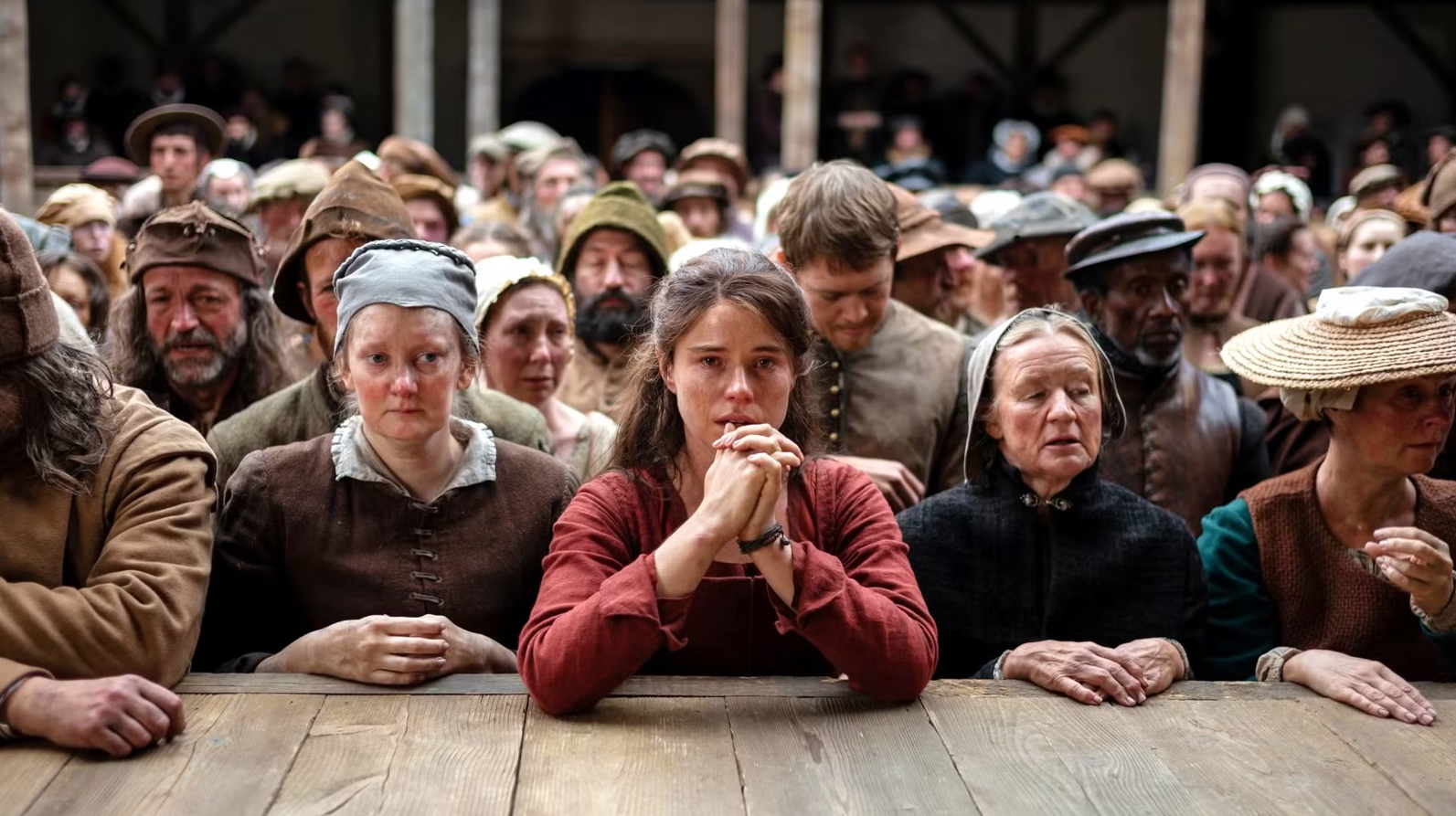
She’s perhaps most impressive in that final sequence, in which we watch her watch a greatly abbreviated production of Hamlet, starring Shakespeare himself as the ghost of Hamlet Senior. Anne initially protests that the play has nothing to do with her son, before eventually settling into the experience and finding herself deeply moved. I, however, remained…unconvinced. 

Hamlet is a highly complicated and deeply weird play, featuring a theater production inside a theater production, an off-stage pirate abduction, a bout of faked madness, and a bunch of Freudian undertones, all held together by the Viking saga of “Amleth” — Shakespeare’s adaptation of which likely has far more to do with the play’s title than Shakespeare’s late son does. The way the play is truncated and condensed here, however, gives a false impression that the play is nothing more than a funeral dirge, a therapeutic tone poem serving as an outlet for all of Shakespeare’s otherwise unexpressed sadness. 

I don’t mean to “well actually” a story that I wish took more artistic liberties, but I couldn’t help but be a bit baffled by the whole thing. Maybe it simply works better on people less steeped in the source material, or maybe it’s something that won’t be fully understood by people who don’t have children of their own. But I do see film criticism as a type of bearing witness to what kind of experience a film provided for someone, and I have to be honest about the fact that this left me with disappointingly dry eyes.  

In Festival Coverage Tags tiff25
Comment

The Fence (2025) by Claire Denis

January 20, 2026

Review by Andrew Swafford

The Fence is a strange movie from Claire Denis – but only because of how straightforward it is. Renowned for her impressionistic and elliptical storytelling, Denis has famously challenged her audience to piece together fractured narratives and peer into the psyches of emotionally distant characters. Even in a film like High Life, which featured big name stars like Robert Pattinson and received an unprecedented marketing push from A24, was a shockingly confrontational and heady sci-fi film that forced its audience to stare into the abyss of monstrous brutality and cosmic indifference. Raised in French Colonial Africa, Denis is almost always concerned with the ways in which our world is built upon a foundation of normalized injustice – but I’ve never seen her explore that idea in a more ordinary way than she does in The Fence. 

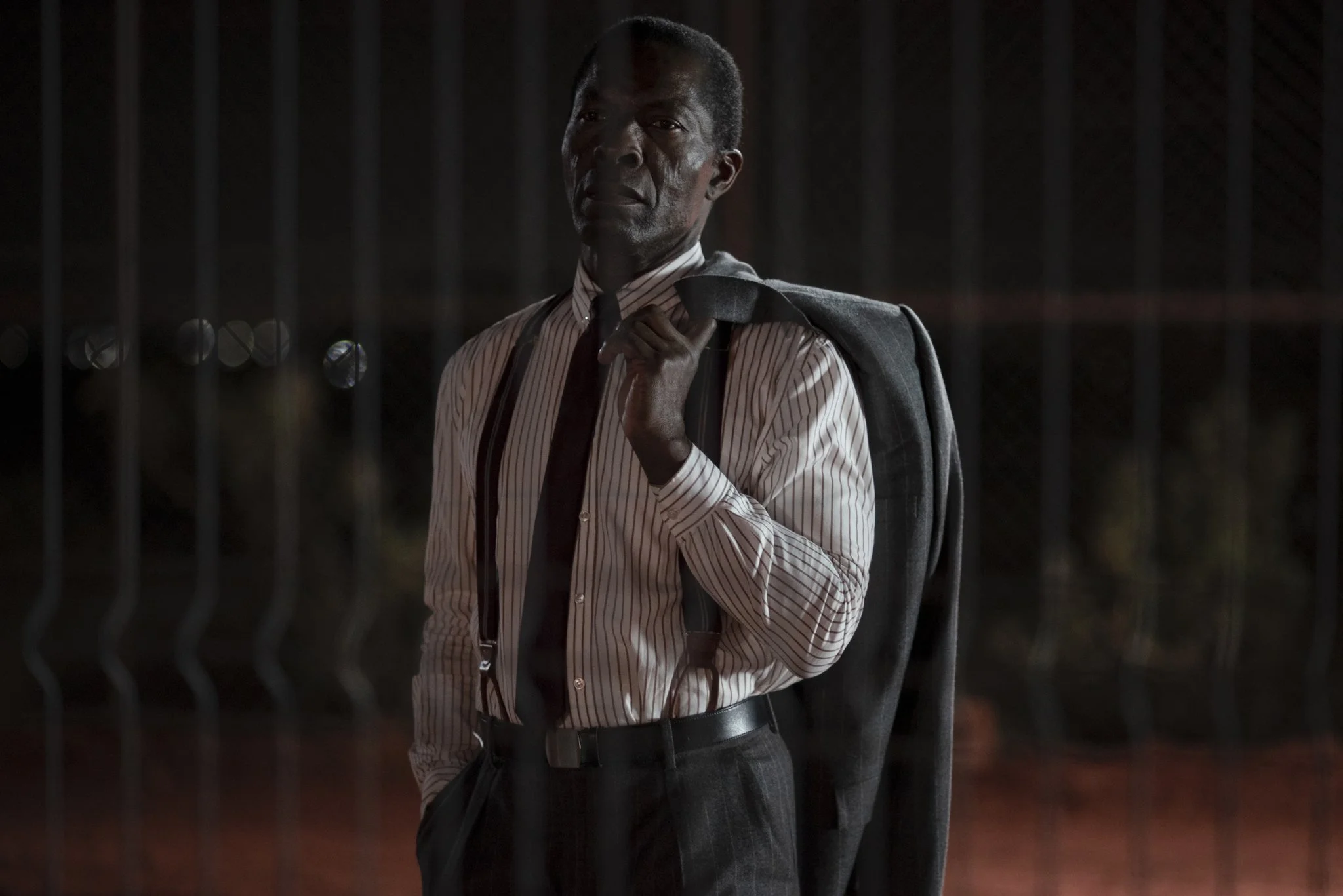
Her first film to be based on a play, The Fence is theatrical rather than cinematic in the most glaringly obvious ways: it takes place almost entirely on a single set, spans only a single night, and is constructed out of one circular dialogue scene after another. The story’s central conflict involves a white factory manager played by Matt Dillon, who has recently covered up the murder of one of his African employees at the hand of a white one. When Isaach De Bankolé shows up to collect the body, he is told to stay on one side of the titular fence while Dillon continually deflects and denies the story of the murder. On this same night, Dillon is also greeting his newly betrothed (and much younger) wife, who has been flown in from England like just another shipment he has placed an order for. The young bride’s presence makes the sustained tension of the nocturnal standoff that much more taut, until it of course explodes in violent and clearly allegorical fashion. 

The best part of the film is obviously the performance of Isaach De Bankolé, who practically steams with repressed anger as he stands firm and indignant on his side of the fence, unwavering in his commitment to giving the recently deceased man – his brother – a dignified burial. Denis has always been a masterful photographer of the human face, and she’s well-practiced in capturing the weathered scowl of De Bankolé, who has starred in many of Denis’s best films. I wish the rest of the film shared De Bankolé’s ability to convey so much with so little, but it is unfortunately little more than a talky morality tale about the obvious villainies of postcolonial capitalism, racist violence, and patriarchal control. I admire Denis’s commitment to speaking her truth about these historical forces that continue to shape our world, but I wish that she had conveyed it in a way that was less easily summarized. 

In Festival Coverage Tags tiff25
Comment

The Christophers (2025) by Steven Soderbergh

January 20, 2026

Review by Zach Dennis

Hidden away in the attic is their inheritance and by god, they’re going to get it.

Barnaby (James Corden) and Sally (Jessica Gunning) are estranged from their father Julian Skar (Ian McKellan), a once-renowned artist who parlayed his success in the 60s and 70s into an American Idol-esque art show that sullied his standing with the public. Not to mention a string of misses that failed to rise to the median level of his best.

They want the best: The Christophers. A series of pieces that Julian made his name on. The first two earned him wide acclaim while the art world waited for him to return with the third and final set. They never came. Instead, they allegedly sit in his attic – unfinished.

Their plan is to enlist the help of someone who can pose as Julian’s assistant for a few weeks and find the paintings in the attic to finish. This will ensure that they can find and sell them at the time of their father’s death. So, they call Sally’s old art school acquaintance Lori (Michaela Coel).

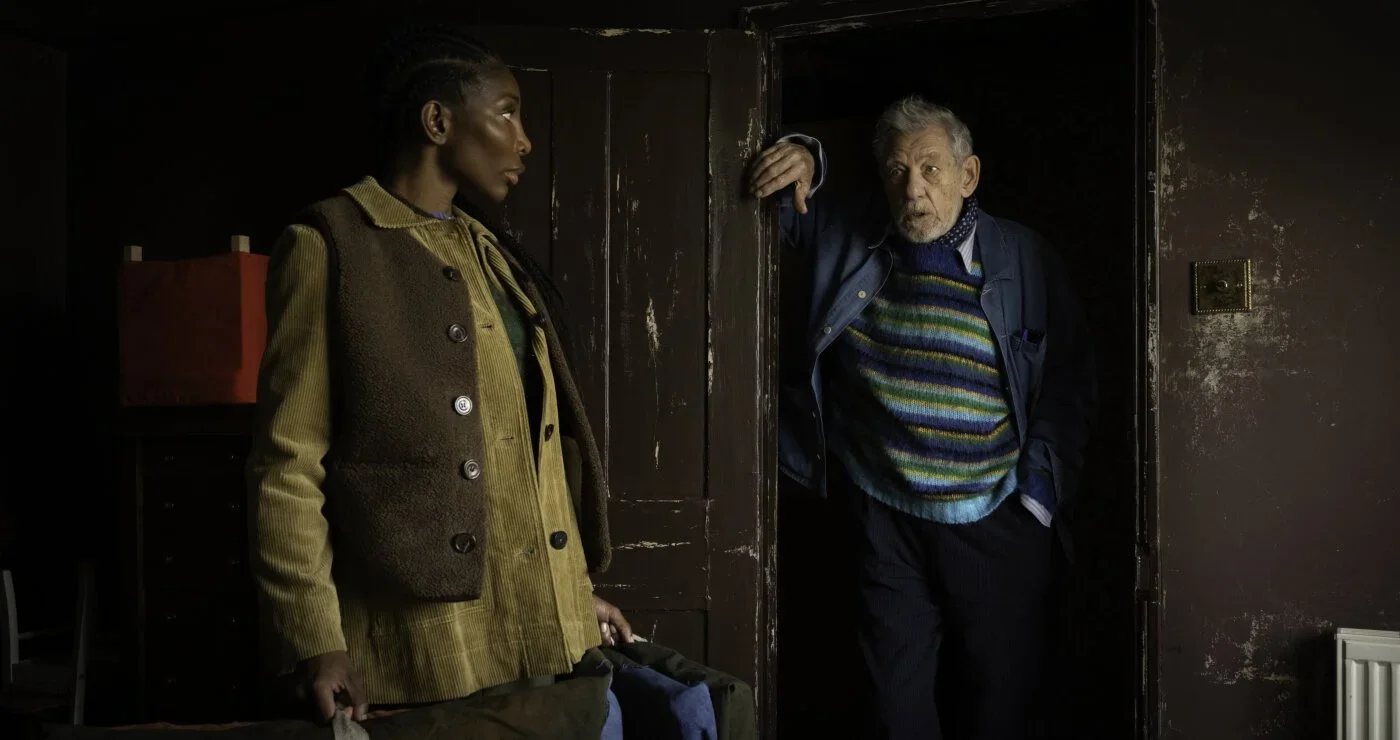
Lori has cut her teeth lately as an art restorer for hire and while a bit reluctant, takes the job from the siblings. She is unimpressed by Julian Skar, almost to the point of hate, and feels content to let him wither away at his computer performing Cameos for whoever has the money and desire. The feeling goes both ways as he’s dismissive of her as well. But he agrees to hire her and leaves her with tasks to complete.

It doesn’t take long for Lori to find The Christophers and begin work on them, but Julian comes in with a say as well.

The Christophers is off the territory that Steven Soderbergh has been treading lately with Black Bag, Presence, or Kimi. This one isn’t set apart by tricks of the camera or even an iPhone in the fold, it sticks to primarily one location (Julian’s home) and is almost a chamber piece for Coel and McKellan, the latter giving what is possibly his best performance on film since donning the robes as Gandalf in The Lord of the Rings series.

Julian is bitter, sarcastic and uninterested in the other lives around him. That works fine for Lori until he begins to take a deeper curiosity into her own; pulling back layers that the artist didn’t necessarily want to open up, especially to her new employer and someone who haunts a bit of her past.

Coel is up to the game. Someone who has been more seen in television than movies, Lori is subdued and dignified. She doesn’t take shit from others and she can smell it on the siblings from a mile away. She’s not as aged with bitterness as Julian is, but some of her own simmers at the surface.

I’m always a mark for a new Soderbergh as he continues to be one of the more interesting contemporary filmmakers working today and this one is no different. It’s softer and quieter than some of his previous work, but leaves with such a profound feeling and performance that it almost slips by you.

In Festival Coverage Tags tiff25
Comment

Blue Heron (2025) by Sophy Romvari

January 20, 2026

Review by Michael O’Malley

The debut feature film from writer-director Sophy Romvari was a big deal for some Cinematarians, but I’ll admit that I didn’t even know her name before I went to TIFF, much less any of the shorts she built her reputation on. Crucially, I missed the Sophy Romvari train when it swept the cinephile nation a few years ago with 2020’s Still Processing, the short film of hers that, in retrospect, seems to have been an important precedent for her feature. Suffice to say, the only thing I knew about Blue Heron was a list Andrew showed me of films that Romvari said had influenced the feature, and at the moment, the only title I remember from that list now is Terrence Malick’s The Tree of Life. That was enough to pique my interest. I’m not sure if lacking as much context as I did is the ideal way to approach Blue Heron, but it worked for me as I walked into hands-down the most powerful film I saw at the festival.

Blue Heron opens as a naturalistic slice of life focused on a family of six who has just moved to Vancouver Island in British Columbia. The film is largely told through the eyes of the youngest child, eight-year-old Sasha, as she and her three brothers (Felix, Henry, and the much older Jeremy, who is from a previous relationship of their mother’s) explore their new surroundings while the parents (called simply “Mother” and “Father” in the credits) navigate the adult logistics of building a new life. Sasha’s experiences here initially seem to be presenting a bucolic childhood that fits the innocent perspective of someone her age: trips to the beach, unstructured imaginative play, nurturing parents—the patient pace of the film allows for sequences to spool out like nostalgic sensory memories, such as a scene in which Sasha and her mother peel potatoes as the woodwinds of King Crimson’s song “I Talk to the Wind” drift in from the father’s workspace in the next room.

However, soon these gentle textures are complicated by Sasha’s brother Jeremy. He barely speaks and seems in many ways disaffected, even alienated from his family as he gazes inscrutably from behind his large glasses. What might initially scan as teen moodiness or a function of his position within the family (as a half-brother, as an oldest sibling by a wide margin) quickly gives way to something much more troubling, a mix of pointlessly provocative actions like threatening to step on his sister’s sand castle or turning on the light in the father’s darkroom while photos are developing and outright dangerous behavior such as climbing on the roof of the house, breaking windows, and shoplifting. The mother and father are at a loss as to how to handle Jeremy, especially as his behaviors escalate in ways that increasingly endanger himself.

This all unfolds piecemeal through Sasha’s eyes, and child actress Eylul Guven works alongside Romvari’s direction to capture with heartbreaking precision the position a young child finds herself in, building a concept of her family at the same time that that family finds itself tumbling toward freefall. She watches with a mix of seeming naivety about the gravity of the situation and helplessness when that gravity’s pull becomes undeniable. The idyllic tone of some scenes is not exactly a feint; instead, there’s a genuine tension between the good and the difficult. Later in the film, Sasha talks about the confusion she feels about the sweetness of her brother in concert with his harmful behavior that she later becomes more aware of. Her brother is someone capable of creating the sprawling beauty of the fantasy maps that he meticulously drafts across the walls of his bedroom and also acting with the erratic behavior that manifests such anguish in the parents and himself.

This stage of the movie culminates with the involvement of social services, which becomes an inflection point not just in the family’s lives but also in the movie’s structure itself. Suddenly, the film’s narrative jumps forward in time to an adult Sasha, who is in the process of making a documentary film about the childhood events depicted up to that point in the movie. Romvari has been frank about modeling Blue Heron after her own childhood and, in her earlier short Still Processing, transparent about the fact that two of her real-life brothers have died, so although it was a surprise to a Romvari novice like myself, it is probably not a spoiler to reveal that in the adult part of the narrative, Jeremy is dead and that Sasha’s film is on some level an exploration of Jeremy within her memories of her childhood.

Trickier to approach as a reviewer is the much bolder, more mind-bending gambit the film makes in following adult Sasha as she works on the film, not just for spoiler reasons but for the simple fact that what Romvari does reaches for the sublime in a way that’s difficult to fully capture. It would not be fair to frame Blue Heron entirely in relation to The Tree of Life, which is a much different film in several important ways, but Malick’s opus does present a helpful framework for approaching the narrative conceit that’s at the heart of the back half of Blue Heron. In perhaps the most iconic sequence of Malick’s film, the grieving mother of a dead son asks none other than God Almighty: Why? and the narrative of the film cracks open to present us the creation of the universe itself in response. Romvari’s ambitions are decidedly less celestial but no less serious, and Sasha’s filmmaking is rooted in a Why? equally as large as Malick’s.

As in The Tree of Life, a plea to understand a shattering tragedy forms a central pillar of Blue Heron, and also as in The Tree of Life, that plea splits the reality of the film open into a transcendent space that contours the ways that tragedies are, on some level, fundamentally unanswerable on a human scale. Befitting Romvari’s decidedly more terrestrial camera, Adult Sasha doesn’t talk to God; she instead conducts a series of interviews to try to help her flesh out the limited perspective of her childhood memories: she talks to the social worker, she talks to her parents, and in each case, even those who were adults at the time can only offer their own frayed memories and experiences, limited by their humanity and locked in by the passage of time. Even when Sasha breaks free of the limitations of time and interviews Jeremy himself, what is revealed is sparse in terms of factual insight—the diegetic sounds of the conversation fade out as the plaintive notes of Brian Eno’s “An Ending (Ascent)” swell, and we watch brother and sister wordlessly reunited on the beach as the music unfurls.

The Overview Effect is a feeling many astronauts experience when they watch Earth from space, as the sight of our planet overwhelms them with a sense of beauty and connection to other human life. Romvari’s use of the Eno track, originally from the score to the Apollo documentary For All Mankind, recontextualizes that feeling to a position among ourselves rather than among the stars. Like the astronauts who have rocketed themselves thousands of miles into the firmament only to find themselves closer than ever to their Earthbound human peers, Romvari’s film peer across the vast expanse of memory and anguish and even death to cling to one of the people with whom her life began. Perhaps no answer exists to our finitude and pain, but if it does, it’s in the unshakable luminescence of our recollections of lost loved ones as much as it is in Malick’s boundless cosmos.

My own brother died a few years ago; in childhood, he had experienced some of the same struggles that Jeremy does here (though a bit less severely), and his death left my family with a lot of questions that honestly will probably never be answered. Asking Why? of the struggles we had that now are consigned to unanswering memories is something each member of my family has had to practice. My family doesn’t otherwise resemble the family in this film much, but in the ways that matter for the movie, I found a deep kinship with what I saw onscreen, both in the child and adult phases of the film. Blue Heron left me deeply shaken and fundamentally seen in a way that doesn’t often happen to me in movies.

I hope there aren’t many people who share enough of the painful particularities of Romvari’s semi-autobiography here to have the reaction I did, but I also hope that people seek out this beautiful movie regardless. Romvari has done something truly special here.

In Festival Coverage Tags tiff25
Comment

BLKNWS: Terms & Conditions (2025) by Khalil Joseph

January 20, 2026

Reviews by Andrew Swafford and Michael O’Malley

Andrew’s Take:

In Cinematary’s coverage of TIFF 2023, I wrote about an avant-garde short film by Ja’Tovia Gary called Quiet as It’s Kept, which was primarily about blackness in relation to white supremacist beauty standards. Built primarily out of borrowed footage from all over the media landscape (from Toni Morrison interviews to YouTube makeup tutorials), the film was able to capture a sense of a larger cultural mosaic regarding its subject. This approach struck me as being part of an emerging genre of sample-based cinema, comparable to so-called plunderphonics music popularized by artists like DJ Shadow and The Avalanches. Other short films I’m aware of that would fit nicely in this category would be Love Is the Message, the Message is Death by Arthur Jafa, Polycephaly in D by Michael Robinson, and now BLKNWS: Terms and Conditions by Khalil Joseph – perhaps the first feature of the genre. 

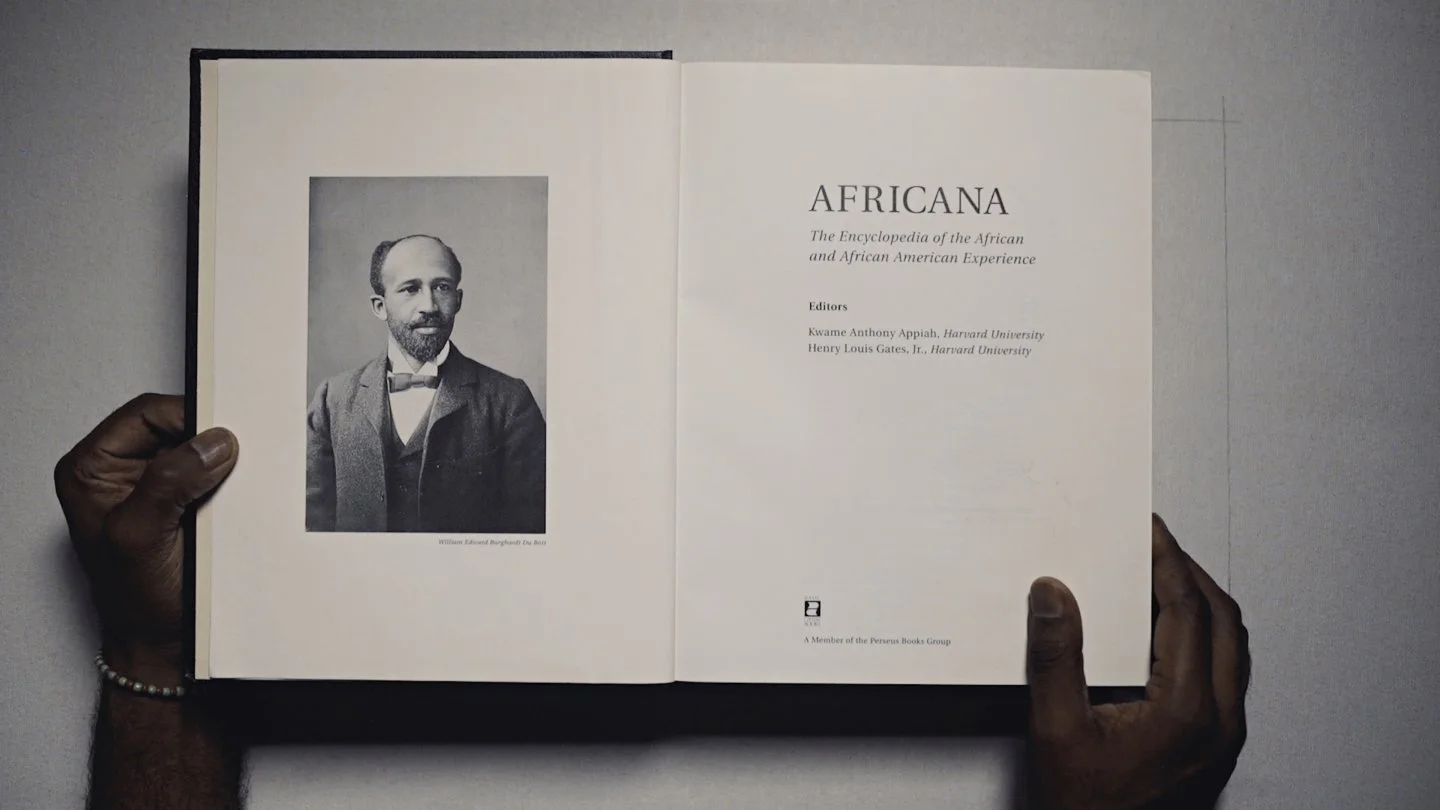
A director primarily known for his work on Beyoncé’s incredible Lemonade film, Khalil Joseph introduced BLKNWS by saying he structured the film like an album – but when the film starts, it announces itself as taking the form of an encyclopedia. A specific encyclopedia, in fact: Africana: The Encyclopedia of the African and African-American Experience, a compendium of knowledge about the African diaspora originally conceived of by W.E.B. DuBois. The prologue of BLKNWS approximates the experience of flipping through this encyclopedia, with video clips of all different aspect ratios and visual quality strobing past the audience at an electrifying pace – and set to an incredible beat, of course. 

Perhaps because Joseph’s film is a feature rather than a short, it soon gravitates away from this hyperkinetic editing style into a different kind of fragmentation. The film has a number of modes it shifts back and forth between, one of which is a fictional news broadcast (BLKNWS) reporting on news from an imagined Afrocentric future (or parallel present) wherein the British monarchy is abolished, cultural artifacts stolen by colonial powers are returned to their countries of origin, and these same colonial powers have been paying reparations for decades. There’s a striking image in the film of W.E.B. DuBois standing in the middle of a hallway containing many doors, and to me, it seemed to suggest the idea of a variety of futures available to us from the present we find ourselves in. 

What might those futures look like? One answer is provided by another one of the film’s modes – a comparatively conventional dialogue-based narrative following a journalist on a strange floating cruise ship tracing the original path of the transatlantic slave trade. The vessel is owned by a young black executive whose family were themselves implicated in the historical atrocity of trafficking slaves, perhaps implying something about the enduring corruption of that kind of blood money. The stretches of the film that take place on this ship are mysterious and languid, shot almost entirely in deep blues and browns and feeling more like a perpetual limbo than a journey to a specific narrative or thematic destination. 

To me, these sections felt like they bring the otherwise thumping rhythm of the film to a dead stop, making me really feel the length of this nearly two-hour feature and wonder whether feature length is the right shape for this new wave of plunderphonics cinema. Perhaps if Joseph were to make the film the length of an album, the experience of watching it would feel entirely different. 

In 2018, Joseph released a 30 minute film also called BLKNWS (sans the subtitle), so maybe that’s what I’m longing for. Regardless, I admire Joseph for refusing to be confined by conventional cinematic frameworks. At one point in the film, one of Joseph’s many borrowed video clips features the line “Style is a resistance to confine oneself,” and this type of shapeshifting, sample-based cinema has exactly that type of style in spades. 


Michael’s Take:

Kahlil Joseph’s new feature film, BLKNWS: Terms & Conditions, feels unclassifiable at first blush. The film is something of a collage, assembled from a magpie’s nest of different video clips, both found and originally created, which makes it neither wholly documentary nor narrative, historical nor sci-fi, avant-garde nor traditional. A dazzling and dense piece of work, BLKNWS jumps from documentary interview footage to TikToks to sci-fi narrative to mockumentary to memoir to historical reenactment with a playful abandon of traditional divisions between media forms. One moment, you’re watching an SFX shot of an Afro-futurist submarine; the next, you’re treated to a clip of the iconic “Back at it again at Krispy Kreme” Vine; the next, you’re watching a scene from the 1962 film Vivre sa vie, re-subtitled to make it seem like Anna Karina is looking for a Wu-Tang Clan album at a Parisian record store. That’s just how things go in Kahlil Joseph’s culturally omnivorous vision.

As with any piece of art, it’s not as if this film is entirely without precedent. Godard’s post-’60s work comes to mind, as does Orson Welles’s F for Fake, or perhaps the perpetual eclectic montage of films like Man with a Movie Camera or the Qatsi trilogy (especially the second and third entries). The most immediate precedent is from Joseph himself, with his 2018 gallery piece BLKNWS. Like the 2018 film for which this new movie is a sequel of sorts, Terms & Conditions purports to be a broadcast from the titular “black news” broadcast, whose anchors present a series of clips with wry and occasionally uproarious commentary.

However, that description doesn’t really capture what’s so singular about the original 2018 BLKNWS or this new variation. In 2018’s BLKNWS, the accumulation of found media clips creates a sort of Pointalist portrait of black life, both mundane and exceptional, where the news broadcast framing device creates the sense that if news media actually chronicled the black experience, this is what it would look like. That element exists in Terms & Conditions as well. Prior to the TIFF screening of the feature, Kahlil Joseph explained that he crafted the film like an album, which was not surprising to hear; Joseph is probably most famous for his visual work with musical artists, having made music videos for acts such as Flying Lotus, FKA Twigs, and Kendrick Lamar, and almost certainly his most widely seen work to date is the companion film to Beyoncé’s Lemonade record, where he was the principal director. With that in mind, both the 2018 film and Terms & Conditions do resemble albums in general in the way that they flow almost in musical movements of rhyming collections of footage and Lemonade in particular in the way they attempt to encapsulate the broader black experience by intermingling an eclectic range of genres of black expression. In that sense, Joseph’s project between these two movies resembles the instantly iconic juke joint musical sequence in Ryan Coogler’s Sinners, where the whole history of African diasporic music inhabits a single shot. As in Coogler’s scene, there’s a celebratory, even utopian impulse to BLKNWS: a vision of black life in which the divisions of history, class, and high/low culture have dissolved into a single musical ecstasy—as one scholar interviewed in the film calls it, “the everyday anarchy of black life.”

However, anyone who’s seen Terms & Conditions knows that what I’ve just described is really only half of the movie, though, and to be honest, I’ve put off talking about the rest of the movie because I’m unsure what to make of it without further viewings. The media montage core of the 2018 film is merely one layer around which Joseph has wrapped two others, making Terms & Conditions considerably more expansive and wildly more complex than its 2018 forebear.

The first of these layers is an almost memoir-esque exploration of the book Africana: The Encyclopedia of the African and African-American Experience, a project begun by W. E. B. DuBois in 1909 and completed by Henry Louis Gates and Kwame Anthony Appiah in 1999. In the film, Joseph recounts how his late father gave this book to Joseph’s brother, Noah Davis, and how when Davis died of cancer, the book came into Joseph’s possession. This plunges Terms & Conditions into history, both universal and personal, in a way that far outstrips the scope of 2018’s BLKNWS. Interspersed with the “black news” threads are photos and pieces of writing, some cited with page numbers from Africana, others from Joseph’s own family archives picturing biographical images such as childhood homes and his father at the Million Man March, as well as historical recreations of an aging DuBois working on what would become Africana in his home in Ghana in the early 1960s.

The second layer Joseph adds to Terms & Conditions catapults the film in the opposition direction, into a far-flung future in which it seems that a political movement inspired by Marcus Garvey has achieved some measure of political success; as part of their program, the Neo-Garveyites now run a submarine that rockets between North America and West Africa in a cross between a cruise and an immersive museum exhibit, allowing black passengers to pass through something called the “Mid-Atlantic Resonance Field” that reconnects them with their ancestral lineage that was subjected to the Middle Passage. A major thread throughout the movie, woven among the “news” and the Africana segments, involves scenes of conversations that occur on that submarine between passengers (one of whom is a journalist writing an article about the submarine) and one of the curators of the experience.

Of course, Garvey and DuBois famously were at loggerheads regarding what the political goals of African Americans should be, which makes the inclusion of these two new layers turn the film into a dialectic between a DuBois past and a Garvey future, with the black news present staked between the two. I’ll confess that I don’t feel equipped to parse the nuances of that dialectic, especially having only seen this rich text of a film once, but what immediately comes to mind is another precedent that Joseph seems in conversation with: Lizzie Borden’s 1983 sci-fi film Born in Flames. Borden’s movie uses a mix of faux-news docufiction with interviews and real documentary footage to explore the aftermath of a future socialist revolution. The film is fairly cynical about the compromises and half-successes that would likely accompany a socialist revolution in the United States, but perhaps its most biting cynicism is the metatextual one of the prospect of socialist revolution in 1983 of all times, long after the radical hopes of the 1960s had been squashed by the reactionary forces that eventually culminated in the election of President Ronald Reagan.

Like Borden, Joseph juxtaposes the revolutionary spirit with a cold splash of struggle. In the 2018 film, this comes with the incorporation of footage of police brutality against black people, but to me, Terms & Conditions feels even more in the spirit of Born in Flames. While the original BLKNWS is very much a product of the Black Lives Matter era in terms of both its content (focusing on social media and the intersecting trauma of police violence) and essential optimism about the power of images to foment radical power, Terms & Conditions feels distinctly post-2020 and post-BLM retreat from the American political vanguard, in the same way that Born in Flames’s 1983 release feels post-New Left. There’s a distinct wistfulness in watching W. E. B. DuBois at the end of his life still wrestling with the same unresolved questions that inflect the 21st century black experience, and the cavernous distance between the struggle of the present moment and the imagined utopia of the Garveyite submarine makes those questions seem all the more mournful.

At the same time, it’s hard to call Terms & Conditions an elegy. The playfulness and energy that Joseph imbues the movie with when chronicling contemporary black life depicts a culture full of verve and creativity and, moreover, tenacity. The revolutionary potential Joseph found in 2018 still exists, if only in the stubborn hanging on, the insistence on finding beauty and play, and a spark that, even with every setback, simply continues to exist in defiance of a world bent on its extermination. DuBois may have died without the completion of Africana, but the work continued—and continues.

In Festival Coverage Tags tiff25
Comment

2025 Toronto International Film Festival

January 20, 2026

Festival Coverage from Andrew Swafford, Grace Winburne, Michael O’Malley and Zach Dennis

Cinematary loved having the opportunity to attend the 50th annual TIFF (or, as everyone is calling it, TIFFty). One particularly special aspect of this year’s festival was that it marked the first time that the entire Cinematary team was able to attend the festival together! We’re extremely excited to have longtime Cinematarian Michael O’Malley represented in this year’s lineup of festival reviewers. This coverage includes long-form reviews of 14 narrative features from 10 different countries, and hopefully it puts a few films on your radar! If you’d like to hear us take a more conversational approach to analyzing these movies, you can listen to our TIFF 2025 recap podcast to hear our discussion of Roofman, Blue Heron, Sirāt, No Other Choice, Hamnet, and more.

Read More
In Festival Coverage Tags tiff25
Comment

Powered by Squarespace