
Review by Alison Swafford
Full disclosure: I haven’t read the novel that Chloé Zhao’s Hamnet is based on (I hear it’s excellent), but I have taught Shakespeare on the high-school level for about a dozen years, and even taught a class entirely dedicated to him for three of those. In all the research I’ve done about the man and his work over the years, the main thing I’ve learned is that we know almost nothing about Shakespeare. We have the plays, of course, but other than that, what scant information we have about the man himself is scattered across a relatively small number of legal documents, upon which his name is scrawled in over 80 different spellings – his “real” name might as well be “Shagspere,” for all we know.
This slipperyness of spelling is something the film draws attention to by only ever referring to Shakespeare’s wife as “Agnes” rather than the far more commonly recognized “Anne Hathaway.” With this in mind, it becomes all the more interesting that the title of Shakespeare’s acclaimed tragedy Hamlet shares a striking similarity to the name of his son Hamnet, who died at the tender age of 11. Due to the lack of linguistic standardization in Renaissance England, “Hamlet” and “Hamnet” might as well be the same name. Surely there’s more to this connection between the ill-fated Prince of Denmark and Shakespeare’s own late son, an untold story waiting to be either uncovered or artistically imagined. What could it be?
Chloé Zhao’s Hamnet boldly posits: he was sad. I hate to be crass about a movie that left what seemed like my entire TIFF theater in an emotional wreck, a movie that won TIFF’s People’s Choice award, a movie that is considered a frontrunner for Best Picture at the Oscars this year, and a movie that Focus Features has marketed with a verifiably bogus quote calling it “the greatest film ever made” – but as an independent critic, I feel a certain amount of duty to be honest about my own reaction to the film rather than getting swept up in awards hype.
While it may be possible that I was simply physically and emotionally fatigued from watching eight other features and eleven short films in the runup to seeing Hamnet as my final film of the festival, the melodrama of Hamnet did basically nothing for me, and I was somewhat shocked to find the rest of the sold-out theater a weeping, snotty mess as we filed out. I’m a movie-crier, and love a movie that makes me cry, but as a piece of art that is clearly trying to evoke that particular affect, I was unmoved.
Getting into the specifics of why is difficult, because the film is so light on specifics: rather than filling in the gaps in Shakespeare’s personal history with any type of artistic license, it chooses to leave most of them blank. The nature of William and Anne’s relationship is a potentially thorny subject – he was significantly younger than her; she was pregnant when they got married; he didn’t live with her or his children for the vast majority of his life; he wrote dozens of love poems about other people of various genders; he ambiguously left her his “second-best bed” in his will – but here all that gets glossed over with a flat and uncomplicated “they fell in love.”
One might think that it would be a delight to imagine Shakespeare (played by the always handsome and charismatic Paul Mescal) wooing an older woman with his words, but the Shakespeare we get here is mostly tongue-tied, seemingly struggling to express himself at every turn. Rather than the rapid-fire repartee between eventual lovers that we see in Shakespeare’s genre-defining romantic comedies, what Hamnet offers are the austere aesthetics of “art house cinema,” people standing around in idyllic scenery not expressing themselves because the cinema ostensibly does the work for them.
After Hamnet’s death (which is the rare case of the movie using artistic license to imagine a scenario that might have caused it), the film offers viewers nothing in the way of connective tissue between the death of Hamnet and the writing of Hamlet. Instead, it chooses to leave his writing process a complete black box in order to remain with Jessie Buckley’s Anne Hathaway as she processes the loss before attending a production of Hamlet in the film’s final sequence. To be fair, Jessie Buckley’s performance is far and away the biggest strength of the film, and I imagine the way that she performs grief here is what is getting theatergoers so misty eyed.
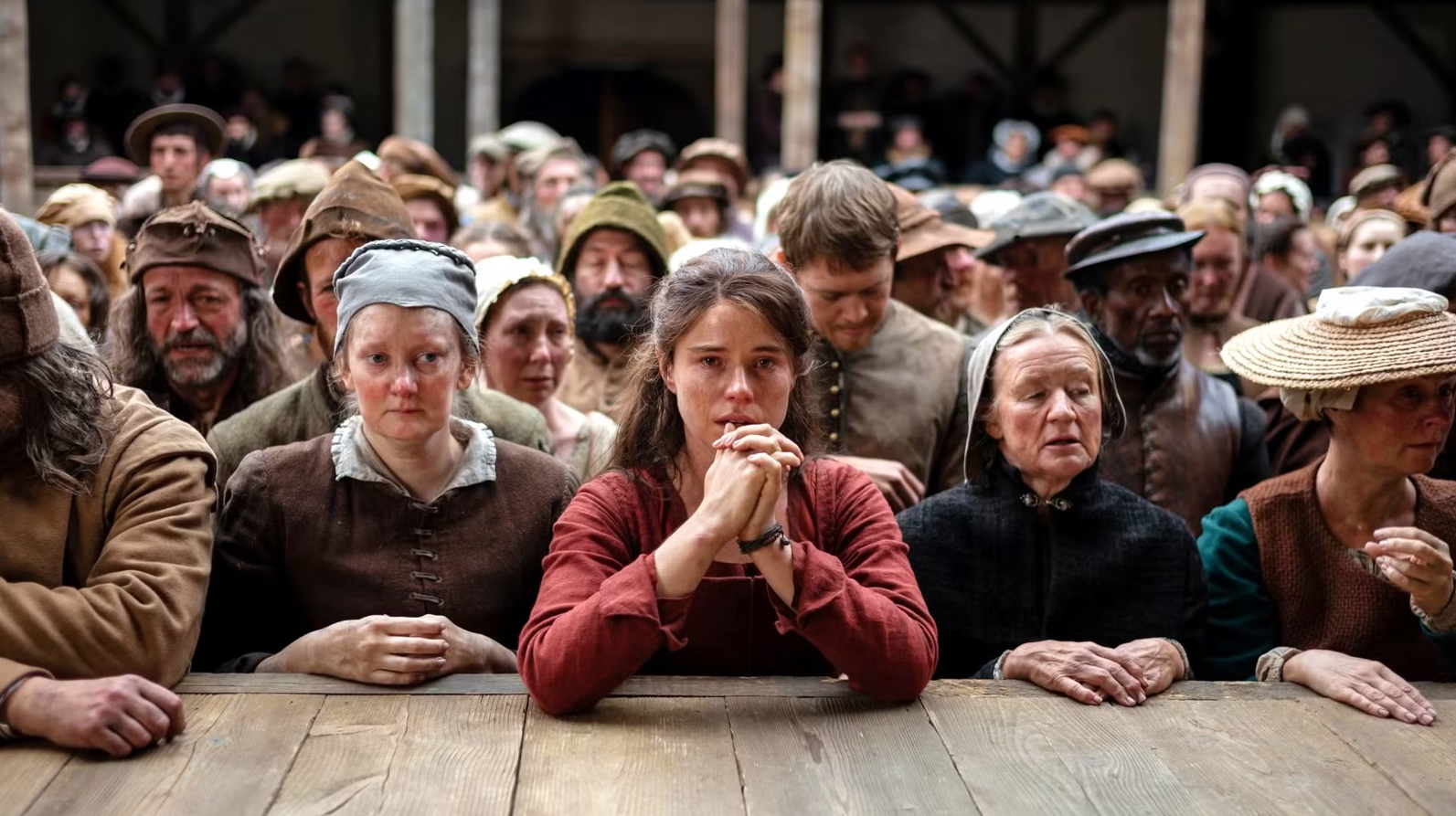
She’s perhaps most impressive in that final sequence, in which we watch her watch a greatly abbreviated production of Hamlet, starring Shakespeare himself as the ghost of Hamlet Senior. Anne initially protests that the play has nothing to do with her son, before eventually settling into the experience and finding herself deeply moved. I, however, remained…unconvinced.
Hamlet is a highly complicated and deeply weird play, featuring a theater production inside a theater production, an off-stage pirate abduction, a bout of faked madness, and a bunch of Freudian undertones, all held together by the Viking saga of “Amleth” — Shakespeare’s adaptation of which likely has far more to do with the play’s title than Shakespeare’s late son does. The way the play is truncated and condensed here, however, gives a false impression that the play is nothing more than a funeral dirge, a therapeutic tone poem serving as an outlet for all of Shakespeare’s otherwise unexpressed sadness.
I don’t mean to “well actually” a story that I wish took more artistic liberties, but I couldn’t help but be a bit baffled by the whole thing. Maybe it simply works better on people less steeped in the source material, or maybe it’s something that won’t be fully understood by people who don’t have children of their own. But I do see film criticism as a type of bearing witness to what kind of experience a film provided for someone, and I have to be honest about the fact that this left me with disappointingly dry eyes.