
Reviews by Zach Dennis and Michael O’Malley
Zach’s Take:
There’s something sacred about the home.
Not that thrown together, quick builds we mostly see today but a home built with wood, brick, stone; it creaks and bends, almost falling apart by each step. But it’s also warm and inviting, there feels like history born within its bones.
It helps in Sentimental Value that the family home feels almost like a cathedral. It almost feels inhabited by ghosts – memories from far off, both good and bad. Etches in the walls signify milestones in life and secret compartments and devices make it magical.
But that’s all lost and flowery now for sisters Nora (Renate Reinsve) and Agnes (Inga Ibsdotter Lilleaas) as they return to their childhood home due to the loss of their mother. After separating with their father, she kept the home for decades but it’s clear that both girls recall more memories of them together than separate.
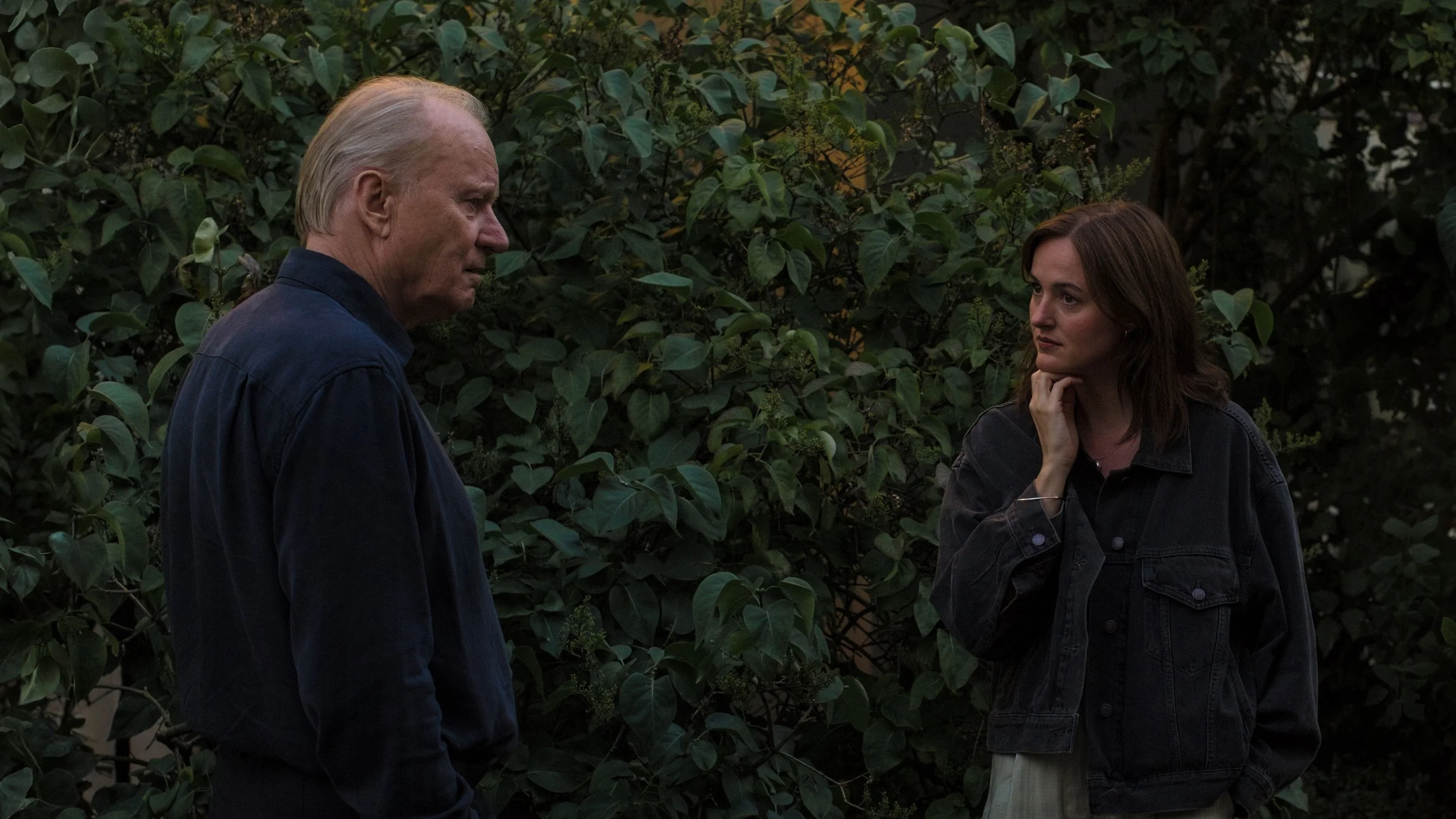
Their father returns. Gustav Borg (Stellan Skarsgård) ran from the home before, chasing a film career that earned him acclaim but has left him dry over the past decade. He has a new project though and he’s back in Oslo to pay his respects to his late ex-wife, but also to speak with Nora, who has become a renowned theater actor locally.
Borg has a history of bringing his familial life into his work. Agnes was the star of a previous film and he speaks emphatically about the experience he had working with his daughter. Nora doesn’t feel the same. The relationship is different now and she resents her father for choosing work over his children. She rejects his script and he’s at zero again.
While in Europe to receive a lifetime achievement award and reflect on his career, he happens upon a burgeoning American starlet named Rachel Kemp (Elle Fanning) who sees Borg’s film that starred Agnes at the retrospective and becomes inspired to meet and work with him. Taking over the role that was destined for his daughter, and with the help of funding from Netflix, Borg sets out to begin his film with the family’s old home serving as the set.
The most familiar film for many filmgoers today from writer/director Joachim Trier is probably The Worst Person in the World, a true international hit that starred Reinsve in the lead role. As a fan of Worst Person, this film feels much richer and moving than the portrait of a 30-something trying to get her life together. If anything, Nora feels more disjointed than Julie in the earlier film.
In this role, Nora is depressed but lacking the clarity to name it that and coasting through life with casual sex with a fellow cast member and putting her total focus into her next acting project. She’s not aware that she is actively crumbling, attempting to creak and bend like the texture of her childhood home but instead leaving a space for a big break.
There is something hypnotic about Reinsve in the film. She drops the unbridled confidence of Worst Person for a person putting on the mask of assurance with the face of fear. A scene late in the film where Rachel contacts and meets with Nora in an attempt to try and understand how to handle the role that she has accepted falls into this attempt to understand a person that doesn’t fully understand themselves.
It isn’t until Agnes sits with her sister and allows her to read her father’s script that she begins to unlock what is ailing her; brought to tears by the fact that her distant father can comprehend the depths of her grief and sadness more than she could in her own soul.
There’s a melancholy to Sentimental Value but also a comfort. You see history play out within the walls of the home where joy, pain, death and grief overcome the space. Maybe it is too much and maybe there is a time that we just have to let go.
Sentimental Value doesn’t provide that answer, but poses that there might be a path forward in forgiveness and the decision to move on.
Michael’s Take:
I never got around to The Worst Person in the World, Joachim Trier’s previous feature, but his new film, Sentimental Value, has the feel of a victory lap. That previous film garnered Trier the most accolades of his career, including Best International Feature and (alongside Trier’s longtime writing partner, Eskil Vogt) Best Original Screenplay nominations at the 2022 Academy Awards. So here’s Sentimental Value: another Vogt/Trier screenplay, and Trier seems to have leveraged his rising profile to make a lush production featuring international stars like Elle Fanning and Stellan Skarsgård alongside his typical stable of actors such as Renate Reinsve and Anders Danielsen Lie—the highest-profile cast of any of his films since 2015’s Louder Than Bombs.
In that context, it’s hard to miss the irony of Sentimental Value’s premise, which focuses on a washed-up filmmaker (Skarsgård) whose days of prestige and industry clout are so far behind him that he struggles to get funding for even modest films, and whose unlikely partnership with a rising American starlet Rachel Kemp (Fanning) is a career Hail Mary formed more out of a last creative gasp than any contemporary relevance. The filmmaker, Gustav Borg, has no illusions about where his career is; throughout Sentimental Value, his character is transparent about his industry struggles, and for as much as he pitches his prospective new film to financiers as a comeback (buoyed by Kemp’s marketability), there’s a palpable sense that it will instead be a swan song.
Rachel Kemp is not actually Gustav’s first choice, though: that distinction goes to his daughter Nora, who is an actress in the midst of her own career struggle as, despite her success, she navigates unexpected waves of stage fright. Nora (played by The Worst Person in the World’s Renate Reinsve) flatly refuses Gustav’s proposition, and not just because of her recent acting troubles. Gustav and Nora’s mother, Sissel, divorced when she was a child, leaving Sissel to raise Nora and her sister Agnes (Inga Ibsdotter Lilleaas) alone while he focused on his career. He has only been intermittently present in his daughters’ lives since, and, now adults, Agnes and especially Nora are estranged from their father. On top of that is the timing: Gustav arrives with his casting proposition in the wake of Sissel’s death, which has, among other things, given Gustav control over the generational family home where he intends to use for the central filming location of his new movie, and while Gustav talks about his film as a chance to reconnect with his daughters, Nora sees the endeavor as rank opportunism from a man who has often treated his family as an accessory to his career. The fact that Gustav’s prospective film is a deeply personal one based on the life of his mother, who committed suicide when Gustav was young, further complicates the issue of whether he is using his film to reconcile with his family or using his family to advance his film.
The film takes Nora’s feelings about her father seriously, but one gets the sense that Trier and Vogt don’t inherently disapprove of the idea of using family history as artistic inspiration. There are echoes of Trier’s own family history here, most obviously his grandfather, Erik Løchen, who was a celebrated Norwegian filmmaker, and Trier peppers the film with small connections to him, such as Gustav’s mother, like Løchen, having been a part of the resistance to Nazi occupation during WWII. In Sentimental Value, filmmaking becomes an invitation for Gustav, like Trier, to ruminate on the threads of his family’s history, and for whatever murky motives and past hurts from Gustav, that act of rumination is productive.
The obvious film canon precedent to all of this (which Trier has openly acknowledged in interviews) is Ingmar Bergman’s 1957 classic Wild Strawberries, about an aging man whose last name is also Borg taking stock of his life on the precipice of a career shift. Trier has a much less metaphysical sensibility than Bergman has (and also a less Nazi-sympathizing one, as Skarsgård has been vocal in reminding people over the past few years); whereas Wild Strawberries’s protagonist finds himself spanning time and space to walk into his own childhood, Sentimental Value instead uses occasional montages that pivot the narrative into the past. That’s perhaps a less brain-bending device than Bergman’s, but these digressions are nonetheless lovely as they pirouette through not just Borg’s own history but also those of other generations who have lived in the house: his grandmother’s, his mother’s, his ex-wife’s, his daughters’.
In fact, for as much as the Wild Strawberries connections present themselves, Trier and Vogt’s screenplay is decidedly more interested in the women in Borg’s life than Bergman’s is. The film opens with one of its historical montages, one that centers not Gustav but Nora and an essay she wrote for school around the time of her parents’ divorce, about the family house to be turned into a film set. The film is full of notes like these that entirely cede the perspective to those outside of Gustav’s own narratives; another occurs when it is Agnes, not Gustav (despite his overtures about plumbing the depths of his matriarchs’ histories), who ends up researching the lives of her grandmother and great-grandmother in a historical archive. Gustav may play the part of the lonely genius, but the film is insistent in puncturing that iconoclasm with the presence of other characters offered as much richness in detail by the movie’s narrative as he is.
The result is a warm ensemble film that finds its weight not in Bergman’s intense, even hermetic interiority but in a collectively shared space. Gustav’s new film has perhaps not righted all the wrongs of the past nor found complete peace with the tides of history, but the people who have participated at least find themselves a step closer toward reconciliation. Film is one of the most collaborative of mediums, and while Trier/Vogt would never be so corny as to suggest an overt healing in Movie Magic, Sentimental Value does find a restorative power in the filmmaking process’s ability to bring people together.
It’s a wonderful movie, one of my favorites of the festival, and I’m excited to see others encounter it.