
Review by Alison Swafford
“Mother, the volcano spoke to me this morning. The old way must burn to ash for the new way to be born.” These lines, presented in whispered voiceover by Anya Taylor-Joy, set the tone for Romain Gavras’s Sacrifice – strange and portentious, but also just a nudge over the line into outright camp.
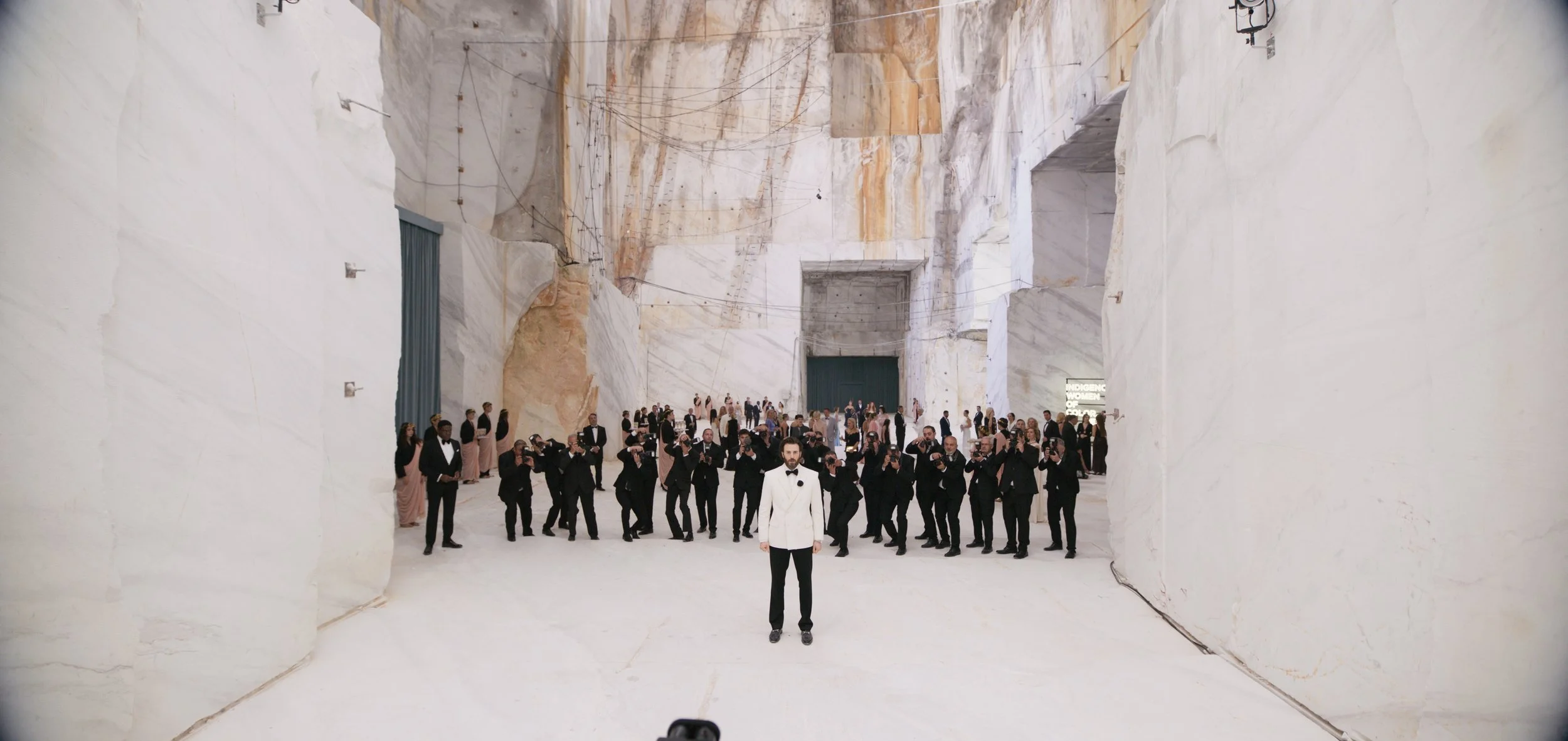
Starring Chris Evans as a recently disgraced A-lister attending a star-studded gala fundraiser for a supposedly environmentalist enterprise being undertaken by the world’s richest man (Vincent Cassel), Sacrifice is an interrogation of self-serving climate change “activism” as it is commonly practiced by the ultra-rich. Cassel’s plan to fight climate change – some sort of underwater fracking operation – seems like it’s both actively destructive and a naked attempt to lay monopolistic claim to an untapped natural resource. Chris Evans sees through this, but only performatively speaks out against it when he knows there’s a camera running to capture a sure-to-be viral moment. After a ridiculous musical interlude provided by none other than the great Charli XCX, the gala is brought to a screeching halt by Anya Taylor-Joy, here playing a radical militant who wants to throw all these people (or at least three of them) in a volcano.
This is the setup for Romain Gavras’s Sacrifice, the latest film in a long line of so-called “Eat the Rich” movies that have been ironically all-the-rage in Hollywood since the undeniable success of Parasite. From The Menu to Glass Onion to Saltburn among so many others, the Hollywood elite has been really interested in pandering to people’s distaste for conspicuous consumption at a moment in history where wealth inequality seems to be outdoing that of the Gilded Age. It’s hard to know to what extent this push for anti-rich agitprop is sincere on the part of genuinely disillusioned screenwriters and to what extent this is simply recuperation, the defanging of previously radical ideas. Nevertheless, it is interesting that Sacrifice is taking this particular tension between ostensible activism and celebrity status as its primary focus.
Taking a voguish subtext and making it text, however, is a double-edge sword, as the central metaphor animating Sacrifice is hardly a metaphor at all. Yes, it will take sacrifice on the part of the ultra-wealthy in order for us to make meaningful progress towards combating the already-ongoing climate apocalypse. Taking that premise and centering it on the well-trod Appease the Volcano God trope doesn’t feel all that inspired, as fun as the trope can be.
If there’s unexpected depth to be found in Sacrifice, it is probably to be found in some third-act revelations about Anya Taylor-Joy’s character that I shouldn’t spoil here – especially since the movie hasn’t even found a distributor yet. I look forward to reading the inevitable analyses of this when the film becomes widely available, which I suspect it will and ultimately think it should. Suffice it to say that there is another layer of what’s going on here, explained quite literally by a late-arriving character played by John Malkovich. The knowledge he shares reframes the way the audience looks at Anya Taylor-Joy’s character, revealing her to be even more of a total weirdo than she already seemed.
And at the end of the day, that’s what I’m most appreciative of Sacrifice for doing: not taking some brave stance about climate change or making a self-reflexive dig at celebrity culture, but simply giving Anya Taylor-Joy a new kind of weirdo to play. She is fantastic at it.