
Reviews by Alison Swafford and Michael O’Malley
Alison’s Take:
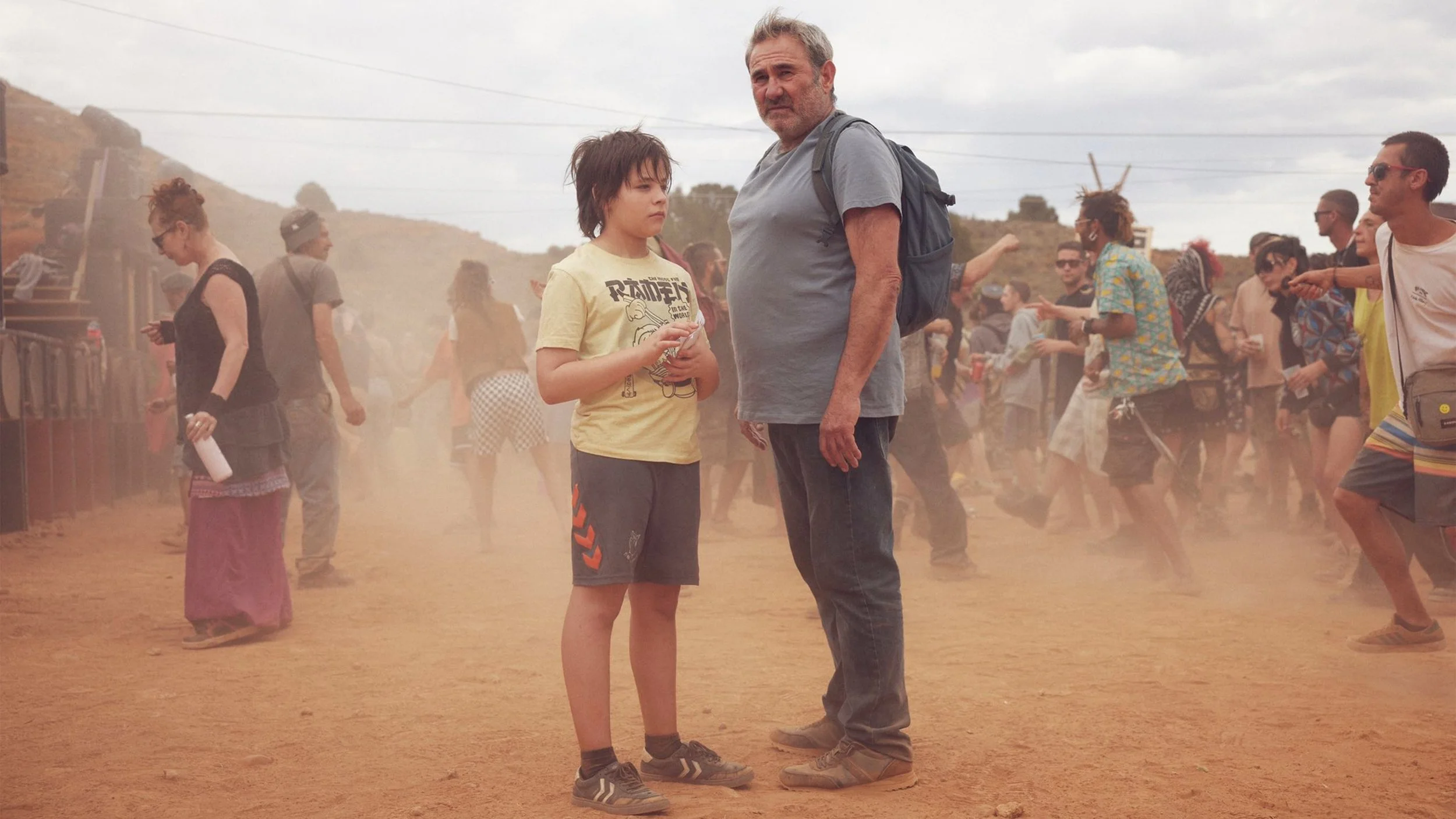
In the opening scene of Sirāt, we watch and listen to an enormous soundsystem slowly and methodically being plugged up in the middle of the desert, one ka-chunk-ing speaker cable after another. The sun bares down on an otherwise empty expanse, and we at first hear nothing but the idle buzzing of the towering speakers until a wall of ghostly, hypnotic rave music finally emanates forward with glorious volume and heft. The camera floats over through a rapturous crowd of eccentric and bohemian dancers before settling on a man who wanders through the multitude, out of place but clearly moving with purpose.
The elevator pitch for Sirāt – man searches for his lost daughter across the Moroccan desert rave scene – sounds like a straightforward thriller, albeit an awesome one. But what Óliver Laxe’s film actually is feels more like the kind of eternal wandering through the desert described by the Old Testament prophets. Laxe’s 2019 film Mimosas was almost literally that, following an increasingly small religious sect as they attempt to navigate a treacherous mountain pass with the corpse of their late leader in tow. By the end of that film, a Kierkegaardian “knight of faith” emerges to guide what remains of the caravan, but the characters of Sirāt have no such luck. This is a hellish road to nowhere that offers no happy ending or easy answers – just a sense that things have gone horribly wrong and could get drastically worse at any moment.
Set in a near-future (or perhaps present) in which an unspecified “war” rages offscreen, the desert offers somewhat of a respite from whatever worse things might be happening in so-called civilization. Although the protagonist initially casts condescending glances towards his raver sherpas, the small community of nomads that make up Sirat’s ensemble cast make for a pretty beautiful found-family of elder goths, disabled folks, and gender-nonconforming misfits. Through continual small acts of care extended to one another, this community offers a briefly utopian vision of a microsociety built upon mutual aid – before that vision is violently destroyed in ways that can’t be predicted and shouldn’t be spoiled. Few films capture the extreme level of fear and tension that so many feel in our ever-uncertain political moment – and even fewer do so with the harrowing intensity that Sirāt does.
Michael’s Take:
The first movie I saw at TIFF was Óliver Laxe’s newest feature, Sirāt. One of the things that is unique about attending a film festival as opposed to regular moviegoing is your ability to enter a movie in a state of complete naivety. I’m used to going into movies with some ambient knowledge of what I’m in for, whether that be from trailers, reviews, word of mouth, press, etc. In a festival, though, you’re often able to experience a film ahead of all of those things: you see a title, a logline, and a showtime, and that’s typically it, unless you have knowledge of the past work by the director or members of the cast or crew.
It wasn’t strictly true that no information at all existed about Sirāt by the time I saw it; it had already had its world premier at Cannes back in May and a full-on theatrical run in Spain in June before coming to TIFF. However, not having paid attention to the movie’s coverage, all I really had were vague impressions that this was something worth watching, alongside a little input from Cinematary’s Andrew, who had watched a couple of Laxe’s previous features prior to arriving at the festival. Functionally, I went in knowing nothing—poetically appropriate for the first movie I caught at the festival.
That said, writing coverage of the film puts me in the weird place of having to take part in spoiling that sort of green experience, which normally wouldn’t be such a big deal except that the sense of unspoiled naivety is kind of key to the film itself. Sirāt is very heavily staked on certain turns in the film catching an audience completely by surprise, and it’s a little hard to talk about what makes this movie so electric and worth watching without at least alluding to those turns.
The film begins like this: in the Moroccan desert, a roving group of musicians set up amps in isolated parts of the landscape and host raves. The opening salvo of the film is almost entirely free of speech as we watch these musicians assemble their towering speakers against the almost surreally barren rocks and then begin the rave. The music, composed for the film by French producer Kangding Ray, is transportive, and Laxe allows long, unbroken shots of the rave to spool out unhurriedly in a striking intersection of concert film and slow cinema. For as punishing as the environment seems, it’s not hard to get swept up in the mesmerizing euphoric abandon of the crowds.
It seems like a good time. This is the first of the film’s feints, and the only one I’ll spoil completely here; what appears at first to be a kind of low-budget Burning Man-style extravaganza is soon revealed to be a refuge from and maybe even an act of defiance against a political crisis. The film never fully explains the sociopolitical context of its narrative, but allusions to trains of refugees and NATO actions seem to indicate that this isn’t just some localized conflict but perhaps the rumblings of a war of apocalyptic proportions. Accordingly, the musicians seem to be operating a kind of anarchist collective based out of their caravan of vans that they use to cart their equipment from desert locale to desert locale as they elide the military maneuvers occurring around them.
It’s a bit unclear how exactly the crowds who come to these raves know about them to begin with, though they’re apparently a well-enough known entity that word about their events spreads to even normie enclaves destabilized by the war—enter Luis, a middle-aged dad with his young son Esteban and dog Pipa in tow. Luis is a normie if there ever was one, literally buttoned-up (in terms of his shirt), and he finds his way to one of the raves with the sole purpose of trying to locate his missing daughter, who he suspects may have come there, though this seems like something of a hail mary; there are allusions to familial conflict between the daughter and Luis (conflicts never completely sketched out in the film but seemingly rooted in Luis’s disapproval of his daughter’s more libertine proclivities), but it’s apparently the political unrest that has made Luis desperate enough to follow his daughter into the desert. The fact that all he has in tow are his son and dog inside a ramshackle van indicates that more of his life than just his relationship with his daughter may have crumbled, and even though the daughter isn’t at the particular rave, Luis accepts the musicians’ invitation to follow them to their next show in the hopes that his daughter may appear.
The movie speeds up considerably at this point as Laxe switches gears from the slow, hypnotic rhythms of the rave first act into a more straightforward roadtrip film. That initial sense of serenity wasn’t built to last anyway, not in wartime. Once the caravan of musicians, Luis, Esteban, and Pipa begin their journey, the film becomes both much warmer and much more on-edge as the scenes vacillate between the growth of a small community as the travelers bond and the brutality of trekking through a desert with limited resources. Tender moments of budding affection between the musicians and Esteban will suddenly morph into tense struggles to dislodge a stuck vehicle or nervous discussions of water rationing. Imagine a roadtrip in the humanist vein of Almost Famous (albeit not nearly as openly crowd-pleasing as Cameron Crowe’s vision), only with the material threats of something like Mad Max or The Wages of Fear, and you’d have something of an approximation of what to expect—at least for a while.
At a certain point, a moment comes when even that rhythm collapses, and one bottom falls out after another. After that point, the film progressively becomes something even more white-knuckled, hellish, and bleak: the feel-bad thriller of the year, in some ways. This is where the balance of festival writing gets tricker, as the back sequence of the film is the place where the movie fully takes shape while also being something best experienced with no foreknowledge. Without giving too much away about some of the truly shocking turns the film makes, that sense of abrupt disaster is central to what the film is about.
Ultimately, Sirāt is an exploration of the liminal space between freedom and collapse. It’s not exactly positing the classic “freedom vs. security” tradeoff but rather a feeling out of the contours of spaces are created as traditional forms of order and hierarchy fall away. The end of the world as we know it is not the end of the world. A scenario such as Sirāt’s in which the nuclear family has shattered, bourgeois mores have dissolved, and nation states have staggered presents new human possibilities: the rapturous sensory freedom of the rave, the intimacy of a nontraditional found family, the reconfiguration of human life into communities of care.
Sirāt is more apocalyptic than utopian, though. The final act of the movie hinges on the violence of the old systems persisting even as the old systems themselves fall apart in a way that Luis and the musicians seem powerless to escape, and the freer forms of human living that the film captures for the bulk of its runtime seem in the long run to be liminal in the most literal sense of the word, i.e. a threshold. As the film concludes on a desolate but ambiguous note, it seems that the characters who survive have passed completely through this threshold into a new world—not likely a better one, given what they have experienced to get there, but certainly a different one than what has come before. Laxe leaves it unresolved what these survivors will take from their liminal moment of freedom into this new age, which I suppose is a question for our current world, too, as we experience the bubbles of human connection within a broader context roiling with violence, ecological devastation, and displacement. These moments of beauty come and go, and then all that remains are the memories and the imprint left on our spirit. What then?
I hope that’s enough to whet an appetite for the movie without spoiling it. I imagine that many audiences will find themselves restless at Sirāt’s languorous beginning, but those who stick around find a film that’s anything but.