Review by Michael O’Malley
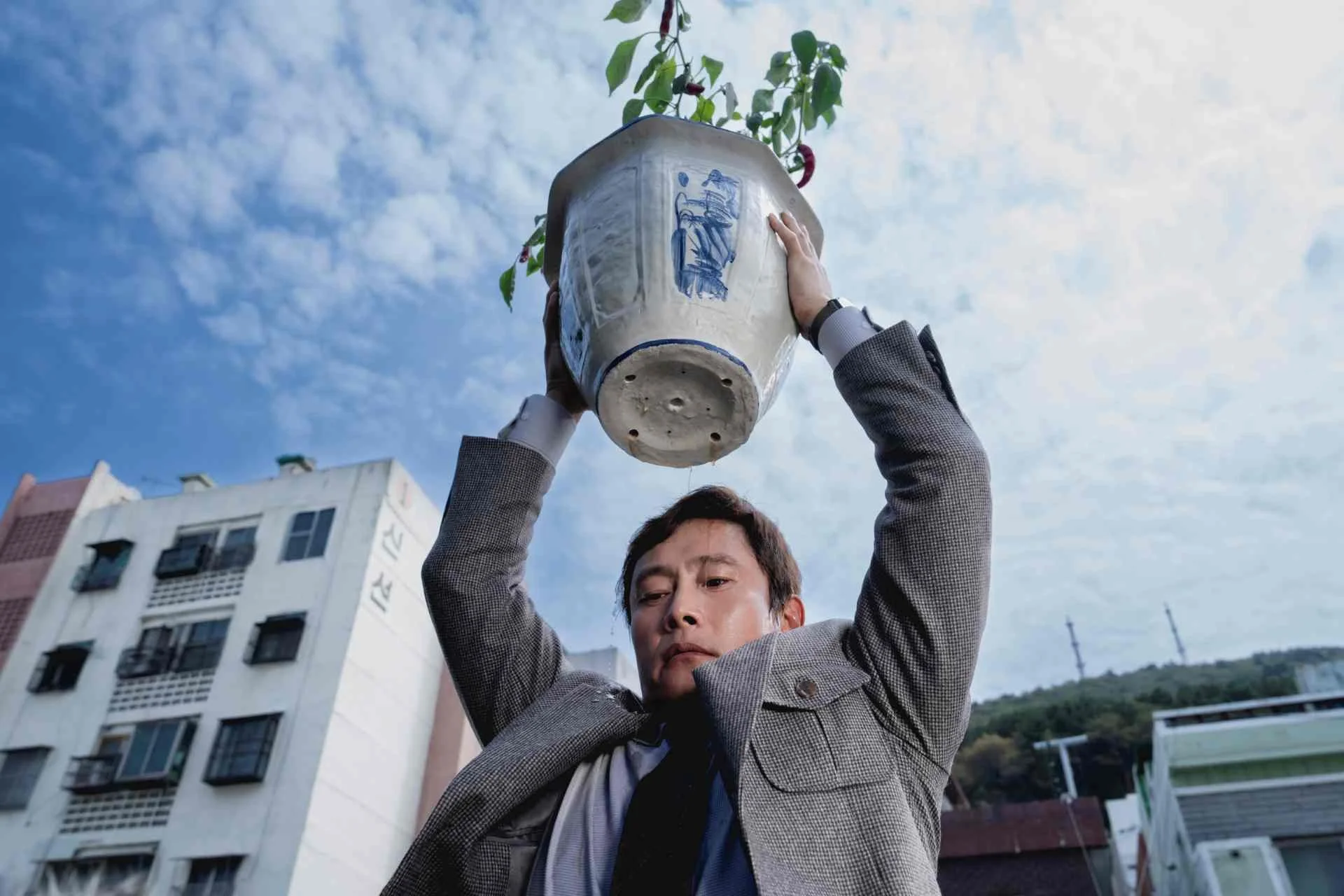
When No Other Choice opens, Yoo Man-su is on top: he’s got a house, a beautiful wife, two children, two very good dogs, and a 25-year career at a paper factory. He’s especially gratified with that career, where he takes deep pride in the gargantuan rolls of paper that spool from the machines, to the point where he scorns the internet because of its lack of paper usage. He even won the prestigious Pulp Man of the Year in 2019—as one character assures us, they don’t give Pulp Man of the Year to any old fool. In short, Man-su says it himself: “I’ve got it all.”
Longtime viewers of the films of director Park Chan-wook may at first find themselves waiting for the bottom to fall out within this comically thick bourgeois bliss. Park didn’t make his name as a chronicler of contentment, after all; this is the man who brought us the cruel ironies and brutal violence of his early-2000s Vengeance Trilogy and the twisty murder plots of 2022’s Decision to Leave. Sure enough, No Other Choice soon delivers the punchline: without warning, Man-su is fired. Upon finding himself in professional freefall, Man-su flails as he tries to claw his way back to the managerial stability he built his life around, but an increasingly cutthroat job market leads Man-su to turn to increasingly drastic measures to find another job in his beloved paper industry. Where exactly the film goes from there is probably best left unspoiled, but suffice to say: irony, violence, and, yes, murder yet again find their way into a Park Chan-wook film.
A new film by Park Chan-wook is an event—for what it’s worth, the only two TIFF screenings I got to that filled up before I could get a seat were the new Knives Out movie and No Other Choice (thankfully, I caught a surprise extra screening of the latter, hence this review). While certainly those two won’t find the same magnitude of audience (I don’t see Park getting multi-film Netflix deals), No Other Choice was probably the highest profile film I saw at TIFF, and it was exciting to be able to do what I’ve seen critics do my whole life, i.e. get an early peak at a widely anticipated new work by a master and anticipate wider audience reactions.
More exciting still is that, at least among his feature films (I haven’t seen his two recent English-language miniseries), No Other Choice feels like something new for Park in two particular ways. First of all, while Park is certainly no stranger to black comedy, No Other Choice is a noticeable step further into overtly comic territory than any Park film I’ve seen. Paper-themed jokes abound, and a lot of the dialogue has an absurd, almost farcical edge to it: such as when Man-su’s family laments, as if it were tantamount to visiting a bread line, that they will have to cancel Netflix now that Man-su is out of work. Even more ostentatious is the film’s use of physical comedy. Several sequences involving Man-su’s job-hunting schemes evolve into full-on slapstick setpieces, pratfalls and all. The grim edge that has often characterized Park films is still there (one notable slapstick scene involves a would-be assassin struggling over weapons with a would-be victim), but tonally, No Other Choice winds up in a place that makes it seem as though Park has been taking notes from fellow Korean auteur Bong Joon Ho, whose films often lace broad comic buffoonery into otherwise serious proceedings.
Park may have been looking to Bong for thematic ground as well, which brings me to the second way this movie presents something new for Park. It’s not as if Park’s movies have never carried political implications (the gender and sexual politics of The Handmaiden come to mind), but No Other Choice feels like the film of his that most directly confronts the contradictions of neoliberal capitalism. The film’s title is first spoken in dialogue during the scene in which Man-su is laid off, when the corporate suits that bring him the news say that the competitive paper market leaves them “no other choice” than to downsize, and the phrase crops up a number of times throughout the movie, each when a character must justify harmful behavior to gain an edge within a competitive world. Under the structures of unfettered market forces, it’s either kill or be killed (sometimes literally).
It’s worth mentioning that the movie is an adaptation of the 1997 Donald Westlake novel The Ax, which itself was inspired by the ’80s/’90s wave of corporate belt-tightening following the Reagan/Thatcher market liberalizations; Thatcher, of course, famously said that “there is no alternative” to capitalism, and with a few thesaurus flips, that slogan could just as easily be worded as “no other choice.”
An understandable fatigue has set in among some audiences regarding the “eat the rich” type of film that has become fashionable in the wake of the Oscar victory of Bong Joon Ho’s Parasite, which No Other Choice may at a cursory glance resemble. However, the masculine middle-class precarity of its plot and the ’90s source material actually positions Park’s film within that decade’s wave of downwardly mobile “angry man” cinema of the likes of Falling Down or American Beauty—maybe an even more ignominious tradition for contemporary audiences than the plug-and-play “eat the rich” sentiments.
But the injection of Bong-style slapstick into a ’90s-style plot of masculine desperation is a savvy move. No Other Choice turns the reactionary tendencies of its ’90s precedents into a wicked farce, not just of the power fantasies of Man-su’s class but of the very idea of the market logic undergirding his actions. By the time we actually see the job that all this competition is striving for—a lonely post monitoring self-operating machines in a mausoleum-like factory—it’s a bitter joke at the expense of the men who have fought tooth and nail against each other to grovel at the feet of capitalism’s rational conclusion: a world completely automated, competition literally dead.
This was one of my favorites from the festival, and I hope people seek it out when it hits theaters.