
Review by Grace Winburne
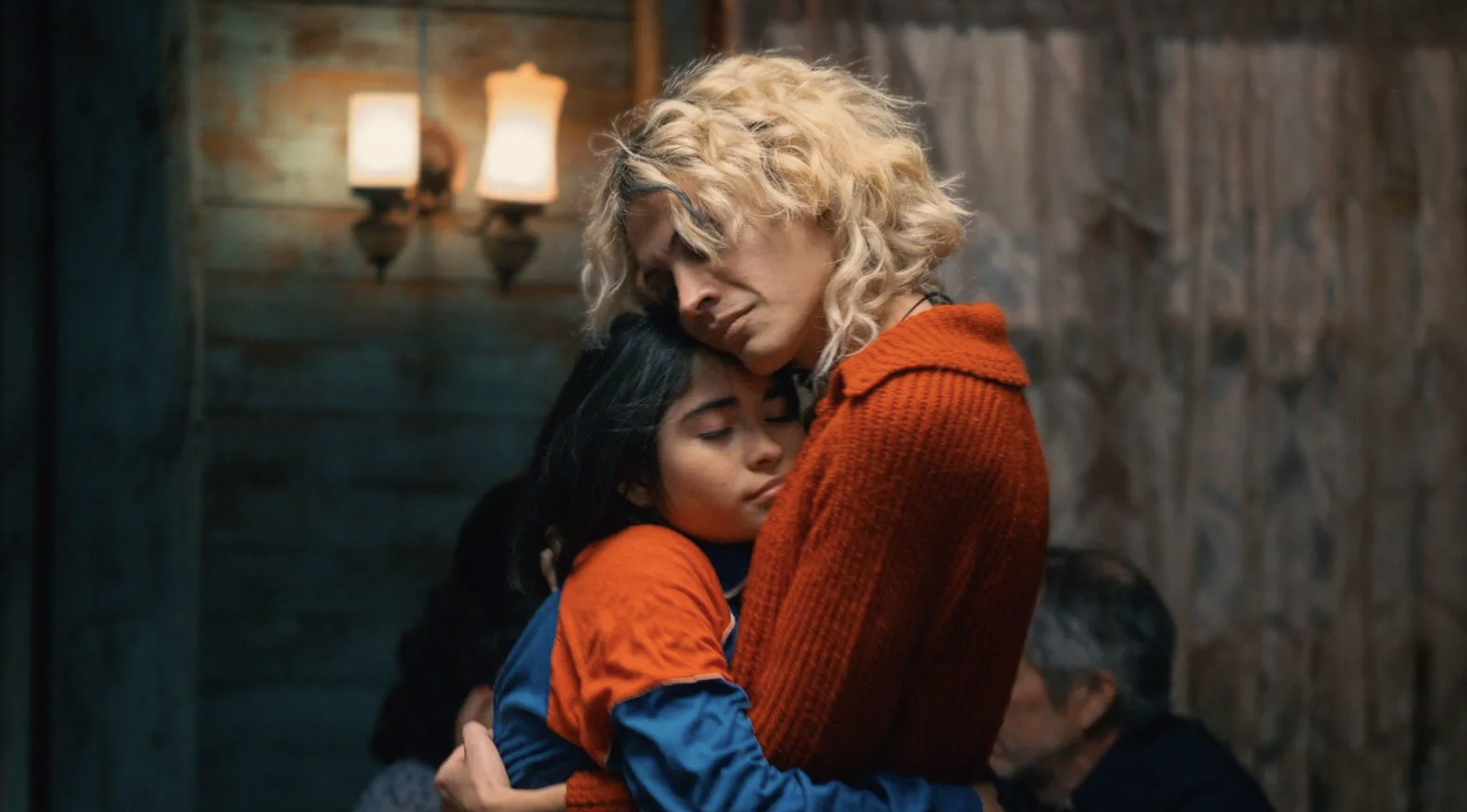
From the directorial debut of Diego Céspedes comes an absurdist, surrealist, Western fairytale about a little girl, and the family of Transwomen in the small Chilean mining town who raise her. We follow Lidia, an eleven year old girl, who lives in the only bar/cantina/club in the small, mountain village. This bar is owned by matriarch Mama Boa, an elder transwoman. Living and working at the bar are all her daughters, self-described transvestite women: Eagle, Lioness, Estrella, and Lidia’s mother, Flamingo. Set in 1982, there is an added historical lens through which we view and contextualize Queer identity and romance, where sex and violence are inextricably linked. There is a plague that is decimating the town. This plague is believed to be transmitted via the eyes, with a single look. The men in the village, and it seems to be populated solely by men, believe that the women, Mama Boa and her daughters, are the reason and carriers for this plague. The men cover their eyes to protect themselves from the plague by day, but by night, the men join in the fun at the cantina where the women are singers, dancers, performers, and for some, their lovers. Only at night can the men of the town find love and acceptance for the women, while during the day they are targets of hate, ignorance, homophobia, transphobia, and violence.
The film is told from Lidia’s perspective, and she spends much of the movie trying to solve this mystery. What is the plague? As Lidia discovers, it is a sickness, an all-consuming sickness that turns men angry, confused, and scared before eventually killing them. It is a sickness that turns her aunts and mother weak and tired, that makes them thin and frail. Where does it come from? It comes from a single loving look, transmitted via the eyes. And why do people die from it? This remains a mystery to Lidia.
Tragic, haunting, romantic, and tender, I was immediately endeared by the powerful and beautiful Transwomen who create a family for themselves. They are an oasis of queer identity, joy, and love in the middle of a barren desertscape. They care for each other, protect each other, love each other, and celebrate each other. They are sisters, proud and defiant, brought together under the love of their Mama Boa. The family protects themselves when the young boys in town bully Lidia. Flamingo and Lidia’s tias, rough up and scare those boys within an inch of their lives. When the family suffers heartbreaking tragedy, they put themselves back together and continue to love stronger than ever. As Lidia grows, Mama Boa teaches her how to defend herself, showing Lidia how to throw punches and to always aim below the belt when fighting a man. Excellent life advice.
The empathy and kindness with which the characters and their stories are treated felt so fresh and new. We’ve seen films with various good and bad depictions of Transness, Queer joy, and plenty of Queer violence, but disguising it all as a “fairytale” told from a child’s perspective takes some of the sting out and makes everything more beautiful. Mysterious Gaze of the Flamingo was awarded Prize Un Certain Regard, at Cannes 2025, and was the Best of the Fest for me, two very prestigious awards.